Given this we felt that it would be useful for us to share an article Brad Olsen wrote in February 2019 on regional New Zealand and China (which also helped inform Brad’s recent comments on the coronavirus here) – which may shed some light on this issue. The article can be found here, and is reproduced below.
Assessing China’s importance to regional New Zealand
Over the last month there have been a range of concerns raised about the diplomatic relationship between New Zealand and China, with the announcement that the 2019 China-New Zealand Year of Tourism launch event has been postponed and government decisions being critical of China setting a foundation for worry.
The concerns around the state of the New Zealand-China relationship highlight China’s importance as New Zealand’s largest trading partner. But which parts of the New Zealand economy are most reliant on Chinese trade, and which regions could be hit hardest by any flare-ups between New Zealand and China?
Commodity trade with China tops $26b in 2018
Trade between China and New Zealand in 2018 made up 22% of New Zealand’s two-way trade. This result makes China our largest trading partner, eight percentage points larger than Australia, our second-largest partner.
Exports to China are dominated by our primary sector, namely dairy, wood, and meat. In 2018, dairy exports to China topped $4.5b, making up 30% of New Zealand dairy exports. Forestry products earned $3.2b in 2018 from China, comprising 49% of New Zealand’s total forestry exports. And meat exports to China provided $2.1b last year, with China leaping above Australia to become our largest meat export market.
Which regions are most exposed to Chinese trade?
Dairy
Dairy is one of New Zealand’s top export earners and activity is highly concentrated in pockets throughout New Zealand. The top ten territorial authorities for dairy exports make up around 65% of total dairy exports. Westland District is the most reliant on dairy exports, with 83% of export earnings estimated to come from dairy (see Graph 1).
Graph 1
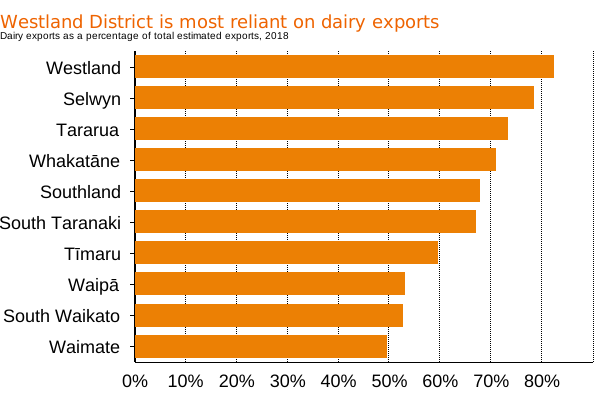
Most of the other areas in the top ten are well-known dairy areas, including Selwyn, South Taranaki, and South Waikato. The economies in these areas are most at risk of any change in Chinese demand.
Forestry
With half of New Zealand’s forestry exports headed to China, areas with a significant forestry presence are exposed to changes in Chinese demand. Forestry exports are estimated to be concentrated more in the North Island, with 94% of Kawerau’s estimated exports made up of forestry products (see Graph 2). Even though Kawerau’s dependence on forestry is due to the presence of the Tasman pulp and paper mill in the town, the area still generates an estimated 6.6% of New Zealand’s total forestry exports.
Graph 2
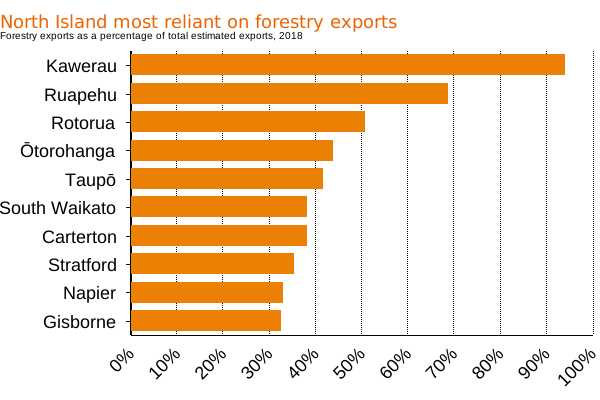
The top ten areas most reliant on forestry make up 40% of total estimated forestry exports.
Meat
Meat exports in the top ten areas throughout New Zealand accounted for an estimated 30% of total meat exports in 2018. Waitomo was the district most reliant on meat exports, with an estimated 83% of total exports in the area being meat (see Graph 3).
Graph 3
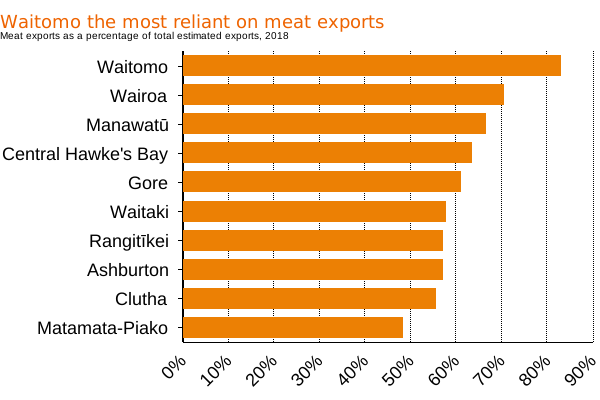
Unsurprisingly, the central North Island appears to have a strong reliance on meat exports.
Nearly 450,000 Chinese tourists visited NZ in 2018
China has become New Zealand’s second largest tourism market after Australia, with nearly half a million tourists from China arriving in New Zealand during 2018. These visitors made up around 12% of New Zealand’s total tourism arrivals in 2018, behind only Australia’s 39% of our tourism total.
Graph 4
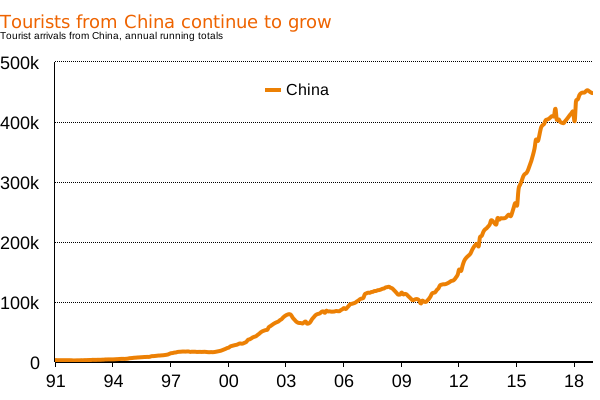
Chinese tourists have more than quadrupled over the last decade, increasing from 102,000 in 2009 to the 450,000 in the last year. As a share of total tourism arrivals, China has increased from 4.3% to 12%.
Chinese tourism spending concentrated in Auckland
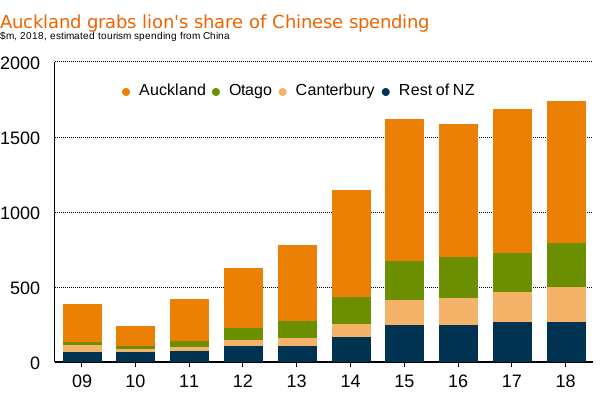
Total tourism spending by Chinese tourists was estimated at $1.7b in 2018, up from $394m in 2009 – a 343% increase. As a share of total tourism spending, Chinese tourism spending has risen from 5.4% in 2009 to 15% in 2018.
Of this $1.7b spent by Chinese tourists in 2018, 54% occurred in Auckland, followed by 17% in Otago and 13% in Canterbury (see Graph 5).
Graph 5
New Zealand trade inextricably linked to China
New Zealand’s exports in 2018 are built on a foundation of trade with China. The regions and territorial authorities with a high concentration of primary exports are particularly reliant on China
These trade ties create potential opportunities as the Chines economy continues to grow and develop, leading to higher average income in one of the world’s largest markets. But recent events highlight the importance of New Zealand maintaining a diversified trade strategy as well and continuing to seek out new options elsewhere particularly in Asia.
New Zealand’s ongoing positive relationship with China is essential to broader economic success for this country. So, if there are issues in the New Zealand-China relationship, we’ll need to work them out, and quickly.
]]>One of the true tests of a society is measured by how it treats its most vulnerable members, particularly the old, the young, the sick, and the disabled. There is a lot of good with New Zealand and New Zealand policy. However, on assisting those unable to provide for themselves, our provisions for people unable to work due to a health condition is an area where we are increasingly failing.
In 2018, 92,500 people were receiving a supported living payment (SLP), [1] making up 1.9% of the population, compared with 15.5% of the population receiving superannuation. Yet over time the amount paid to those receiving the SLP has steadily declined relative to both wages and other benefit payments like superannuation.
This article outlines why the SLP needs to rise drastically and concludes that we need to honestly evaluate whether we are giving those who are excluded from the labour market the opportunity to live a meaningful life.
Some back-of-the-envelope calculations show it would cost $633m per year to align SLPs with superannuation rates – a cost dwarfed by the $13b spent on superannuation alone in 2018. With the Welfare Expert Advisory Group report expected to be released soon, addressing this unequal treatment should be high on their priority list.
Some background on supported living payments
The passing of the Social Security Act in 1938 established the modern benefit system we still see broadly today, with a version of superannuation and the supported living payment (SLP) introduced. At the time, both offered the same payment rate. The justification for this was clear from the description in the Act and the corresponding description of the 1898 Old-age Pensions Act – if you cannot work permanently, society will give you the funds to enjoy a minimum standard of living.
Over time the tax treatment and eligibility for superannuation and SLP payments changed. But the principle that the base payment of both would remain the same was followed until the early 1990s.
The 1991 Budget (the Mother of All Budgets) saw a series of benefit cuts, some by as much at 25%. [2] However, as SLP benefits and superannuation were justified based on need, the government refused to cut them.
Instead, other attributes of superannuation and disability payments were changed (for example the eligibility age for superannuation, and how benefit payments were actually provided to recipients).
A new payment for superannuitants living alone was introduced – which was the reason for the 1992 decline in the ratio (see Graph 1). As part of these reforms, additional support to those with specific needs was intended to be provided through targeting supplementary benefit payments.
However, the reality has been that supplementary and special assistance can be hard and costly to access, and social welfare organisations have been designed to make this more difficult given the disproportionate fear of “welfare bludgers” – a concept which is considerably difficult to comprehend for those shown to be unable to work due to health conditions.
Disability payments fall behind other supported communities
Over time, SLPs have significantly declined relative to superannuation payments (see Graph 1). In 1990, SLPs for a single person were 105% of the single-person superannuation rate.
Graph 1
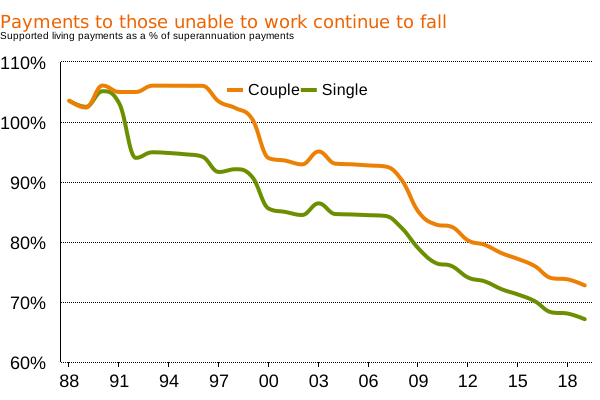
Ten years later in 1999, the single-person SLP was just below the single-person superannuation rate (at 94%). It has slipped even further since, to 83% of the single-person superannuation rate in 2010, and in 2019 is currently worth just 73% of the single-person superannuation rate.
Superannuation keeps pace with wages, but disability payments fall
Over time, supported living payments have also declined as a proportion of average weekly wages. This decline has occurred even as superannuation payments have remained a steady proportion of average weekly wages. Having SLPs decline relative to the average weekly wage indicates that although workers and superannuitants have maintained a similar trend of living quality, those physically unable to work have seen the funds they receive dwindle lower even as costs increase.
Over the past thirty years, SLPs have declined from 33% of the average weekly wage in 1989 to 26% in 2018 – a eight percentage point decrease (see Graph 2).
Graph 2
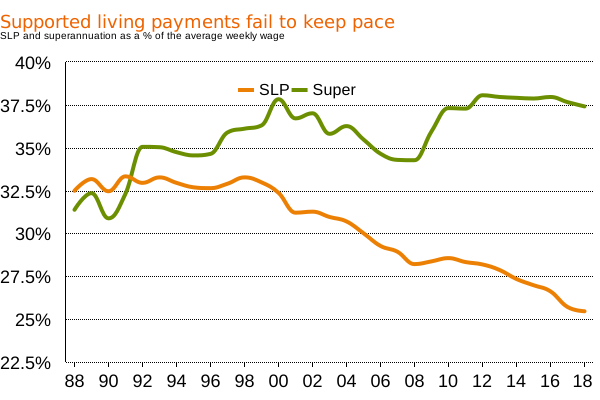
Over the same period, superannuation as a proportion of the average wage has actually increased, from 32% in 1989 to 37% in 2018 – a five percentage point increase.
It should be noted that there are added payments that someone can receive through the benefit system based on need, including the Accommodation Supplement, disability payments for regular health costs, special disability payments, and the community services card.
However, these additions can be accessed by someone on superannuation as well as the SLP – hence why the disparity in base payment rates is uniquely unfair. Furthermore, these additional payments don’t necessarily get provided to those in need .
Supported living payments must rise to protect those unable to work
This divergence in benefit payments to the old and the disabled implies that the support society should provide to the old is greater than the support for the disabled – a sad reflection when previously society valued both similarly in recognition that they could not work themselves.
That’s not to say that those receiving superannuation should receive less (that’s a totally separate aspect), but instead that those unable to work due to health conditions should be paid at a similar if not the same rate as superannuation.
It’s also important to point out that there are many different views about whether certain minimum incomes (like superannuation or supported living payments) are sufficient or not for individuals. But given we commonly discuss superannuation as a “top-up” to a retiree’s income, and that it would be difficult to get by on superannuation payments alone, it’s highly concerning that New Zealand provides a much lower payment to those unable to work due to health conditions.
Someone who has had an entire working life to save income for their retirement may have been unable to or may have faced difficult circumstances and hence deserve our support. That’s not at question. But someone suffering from a disability that keeps them permanently out of the labour market has, at most, a limited opportunity to access the labour market to try to gain income for their livelihood. This lack of opportunity justifies why someone receiving a supported living payment should be paid at least the same if not more than the superannuation rate – not less.
To be clear, receiving a supported living payment isn’t a case of someone avoiding work. Work testing for this benefit must occur every two years, even though they also need to show the condition is keeping them permanently out of work. For those who receive SLP, the lower payments are probably not the most important issue they struggle with –when many people receiving this payment want the opportunity to be involved in the labour market, want fair payment for those who support them (especially family members), and are concerned about negative social treatment due to their condition. But treating these people in the same way we treat others would be a start.
As a society, we value the idea that we give people the same opportunity to live a good life. When someone is dealt a rough hand, as a community we should do more to support them. Our willingness to let payments to those with disabilities decline relative to those on superannuation and relative to the average wage indicates either a lack of empathy, or an inadvertent hypocrisy in terms of the way we have established our support for those unable to work themselves.
It seems only right that we correct the unequal benefit payments, starting by increasing supported living payments to the same level as superannuation, and then keeping payments in line with superannuation and wage rises.
]]>The TIA’s report generates extremely unusual results. For example, the Association claims that 15%of Upper Hutt residents’ jobs depend on the tourism industry, while only 9% of residents’ jobs in Queenstown-Lakes District depend on tourism. This result defies logic and an assessment of the TIA’s methodology suggests that it should be taken with a grain of salt.
The TIA uses Statistics New Zealand’s Tourism Satellite Account as a starting point for their assessment of regional tourism employment. Although it makes sense to begin with the TSA when looking at aggregate tourism employment in New Zealand, this is where our support for the TIA’s methodology ends.
The TIA uses flawed methodology to disaggregate the TSA’s national level tourism employment data into territorial authority level tourism employment. The Association disaggregates the data by using each territorial authority share of total national employment across all industries from the Census and then applying this share to national tourism employment in the TSA. The key problem with this crude method of decomposition is that these employment shares are unrelated to the tourism industry and can vary due to any number of reasons. For example, using the TIA’s method, if a 100% export-orientated firm decided to locate a factory in Upper Hutt that created 1,000 new jobs then a portion of these jobs would automatically be attributed to the tourism industry in Upper Hutt.
In contrast, when we calculate tourism employment in a territorial authority, we have an economic model that makes use of a range of data sources including the Tourism Satellite Account, guest nights, visitor expenditure data from MBIE, and Infometrics’ regional GDP estimates. As a result, variation in our modelling of tourism employment between regions is driven by regional-specific tourism data that contains actual information on visitor spending patterns and accommodation demand.
]]>Having so far failed in my search for a reasonable justification for restricting Easter trading in New Zealand, my mind then turned to a more consumer-orientated motivation that transcends religion and worker welfare. Perhaps I am the odd one out and the majority of society want the shops to be closed at Easter simply because it allows them to enjoy a quiet day, free of temptations to hit the shops and consume.
Is this the only fair justification – and is it a reasonable justification in of itself?
]]>In announcing its new monetary policy proposals, Labour has shown an admirable ability to think outside the square. …. Unfortunately, there are a lot of problems with Labour’s idea and the assumptions behind it.
His list of 10 questions are:
- Should KiwiSaver be compulsory?
- Does New Zealand really have a savings problem?
- How good is Australia’s compulsory savings scheme for their economy?
- Do compulsory savings programmes actually increase savings anyway?
- What effect do compulsory and limited-access savings have on the robustness of financing decisions?
- Is New Zealand’s permanent current account deficit really a problem?
- Are our ‘high’ interest rates really caused by our rigid monetary policy framework?
- How much of our mortgage interest payments go overseas?
- Does the export sector really need a lower exchange rate?
- What about compliance costs for businesses?
His answers to these questions give a case for why the VSR may not be good policy at all. What are your thoughts?
]]>
There are many other examples of low lying fruit in the policy domain where a combination of entrenched interests and innate conservatism inhibits movements to welfare enhancing changes (eg a flat tax/guaranteed minimum income tax benefit system, redesigning GST on a origins basis, and global free trade).
The claimed benefits of adopting the Chicago Plan are truly profound, and if true would have a larger impact on the welfare of New Zealanders than most other issues that dominate political debate.
It would seem to be a good use of government resources to have this issue investigated thoroughly to, either put to bed the claims if they are illusory or to begin implementing a change if they are indeed genuine.
The potential benefits David notes are:
1. Having to obtain outside funding rather than being able to create it themselves would reduce the ability of banks to cause business cycles due to potentially capricious changes in their attitude towards credit risk.
2. Having fully reserve-backed bank deposits would completely eliminate bank runs, thereby increasing financial stability and allowing banks to concentrate on their core lending function without worrying about instabilities from the liabilities side of their balance sheet.
3. Allowing the government to issue money directly at zero interest, rather than borrowing that same money from banks at interest, would lead to a reduction in the interest burden on government finances.
4. Allowing a reduction in private debt levels as money creation would no longer require the simultaneous creation of mostly private debts on bank balance sheets.
5. It generates long term output gains from a lower interest rate profile, lower tax rates (as the government can earn more from seigniorage), and lower credit monitoring costs for banks.
6. It can allow steady state inflation to drop to zero without posing problems on the conduct of monetary policy. A critical underpinning to this result is the greater ability to avoid liquidity traps as the quantity of broad money would be directly controlled by policy makers and not dependent on bank’s willingness to lend, and because the interest on Treasury credit would not be an opportunity cost of money for asset investors, but rather a borrowing rate for a credit facility that is only accessible to banks for the specific purpose of funding physical investment projects, it could become negative without any practical problems.
This does sound to good to be true. Hence why, as always, there are trade-offs.
In this case, there is full reserve banking, and people’s liquid deposits actually are available for withdrawal “on demand”. As a result “bank runs” become impossible. However, since the funds cannot be lent out, the rate of return on those funds would disappear – in fact banks would be simply charging people a service fee to give them a safe place to hold their money. This implies that charges for saving with the bank will rise.
It is terms deposits that could be lent out, for an equivalent maturity of investment – as a result “maturity mismatch” would disappear, but the advantages of “maturity transformation” would be lost in the regulated banking sector. Note: Equity financing would allow banks to lend out funds, and the switch to equity financing could well be seen as a plus!
As a result, the fact that currently accepted forms of banking would be banned would imply that they move into the “unregulated” banking sector – potentially increasing the risk of financial crises rather than increasing them.
Timing effects also matter. If banks funding will move with the economic cycle in a lagging way (and as lending is pinned to funding in this case, so will lending), and as a result their ability to lend will be as well. In this environment, it seems a bit of an overstatement to say such constraints will get rid of the business cycle.
Furthermore, the details of the transfer associated with the plan matter – if the shift to reserves through government intervention and corresponding seinorage is a implicit one-off tax, people will lose some trust in government and may expect similar tax grabs in the future.
Remember, high debt levels have downsides, but they can also be a sign that very heterogeneous lenders and borrowers are meeting in the marketplace – the DSGE framework doesn’t capture this, and the associated costs are as a result being ignored.
Do you agree the plan – which would cleanly separate the “deposit holding” function of banks from the “lending and credit creation” function is a good idea? Are these potential downsides too much? Or do we simply need more details before we can decide?
]]>]]>Regardless of whether you are an Air New Zealand loyalist, or just choose whichever airline is cheapest, it is to be hoped that Jetstar’s recent set back is not the beginning of a slow decline for the airline. After all, for consumers and businesses alike, the competition between these two airlines is vital for keeping domestic air travel prices low and regional air connectivity high. Even in regional centres where Jetstar does not fly, a lid is still kept on Air New Zealand pricing by factors such as the proximity of main-trunk airports with low-cost connections and even the threat of Jetstar investing in its own regional turboprop capacity.
Cuba provides an interesting case study in how government policies can help individuals coordinate in their choice of job and educational attainment. However, it also shows some of the costs of trying to generate a “dynamic comparative advantage”: the misallocation of human capital as people are pushed into specific areas, the restrictions to freedom required to solve the time inconsistency issue between government and the service providers, and ultimately the risk of being exposed to an industry ‘picked’ by a government.
In truth is does appear that one of the key issues, when looking at how the system works, is the freedom of choice of the individuals involved – understandably, people’s beliefs and judgement around this in ethical terms should drive their view on what is appropriate.
]]>
Best Start is a typical case of a policy solution being developed to an inadequately defined problem, mixed up with a dose of admirable sentiments and a sizable helping of realpolitik. We don’t have a robust definition of poverty, and for children who are not being adequately provided for, it is difficult to arrive at a fair apportionment of responsibility between the family and society.
What are your thoughts?
]]>
]]>Overcapacity in the retail sector following the boom years up until 2007 meant there were not enough customers to go around once the economy hit the wall. The increasing prevalence of online shopping, particularly with overseas-based retailers given the high exchange rate, further eroded the market share of local firms. According to the NZIER’s Quarterly Survey of Business Opinion (QSBO), the profitability of merchants at the end of 2008 was squeezed harder than at any time since 1983.
The good news is that 2014 could be the best year for retailers for some time.