
In a cool interview over at interest.co.nz Geoff Simmons outlines what is going on with the TOP party, which he has just become leader of. For the sake of clarity I think he’ll be an excellent leader for this party. What I want to concentrate on is this quote though:
How can the public know I am serious about the long haul? When Cortez took on the Aztecs, he trashed his ships to make sure his men had no choice but to fight with everything they had. The reason I bring up that story is what I am doing right now is pretty much career suicide for an economist. There’s no going back.
Haha, this is good – I like the nifty description of a commitment mechanism. But I’d like to ask a couple of questions about it.
- Is this true.
- Should this be true.
For the first one I don’t know, as I’m no-one important enough to make these sort of decisions – I’m just a random guy that writes on a blog. Given Geoff has already stood as deputy-leader I’m not sure that signing on as leader for an extra term will make any difference. The guy has economics, writing, and oral skills which a bunch of public and private sector organisations would be happy to use.
But if it was true, should it be? When discussing whether economics was consequentialist I revisited the positive-normative distinction. For economic policy this is:
A positive economic analysis is about comparing outcomes – describing what occurs and why, given shared definitions of what the key elements are, but not of how they are valued. A normative economic analysis is about choosing from a set of outcomes – it requires valuing these elements of our analysis.
Being “an economist” as a profession/career is about describing the trade-offs that exist between outcomes of policy. Being a politician is about associating values to outcomes and selecting one. Someone with economics training like Geoff has clear training in understanding the trade-offs that exist between these outcomes – but is not necessarily more equipped to associate values, and definitely not armed with values that are simply more valuable/important. However, the training allows someone like Geoff to articulate those values more clearly because the trade-offs involved are explicit.
In this way, economists should not be scared of getting into politics – economists are people with values too and should be allowed to represent them. Their training does not make their values more important – but it does give them a language for communicating those values more clearly.
The problem with economists going into politics is a belief that their values are more important – not the fact that they are economists. The career suicide “should” be when an economist shows an inability to separate normative and positive roles, not the fact that they dared to have a normative position as a human being.
Now in this way it shouldn’t be career suicide for Geoff – and hopefully if the politics thing doesn’t work out he still has plenty of opportunities to jump back into the exciting world of analysing trade-offs for a living! I just thought this was a cool idea to think about.
]]>- What areas had the highest/lowest turnout? (i.e. where is participation high/low)
- What areas had the highest raw number of votes? (“who elects the mayor”)
Maps addressing these two questions are below. Note that they don’t include Waiheke, mainly because it’s not part of the “Coastlines” shapefile I used to crop the board boundaries and I decided the effort of separately mapping the board area to the “islands” geographic shapefile wasn’t worth the effort given I have a day job (i.e. I am lazy). If you are wondering, turnout on Waiheke was very high (58.6%).
Percentage turnout

Number of votes 
]]>
The Greens talk poverty and social justice, but the poor aren’t listening – and they’re certainly not voting for them. Look at these telling statistics from the poorest electorates in the country:
In Manurewa, in the crucial party vote, just 868 people voted for the Greens; in Manukau, East it was just 744; in Mangere, it was just 865.
Now look at the two most wealthy suburbs in NZ:
In Epsom, the Greens got 3415 votes; in Wellington Central, they got 8627 party votes, more than Labour’s 7351; in Auckland Central the Greens got 4584 votes, compared to Labour’s 4758.
I would really want to see some more numbers around this, but if this is a general trend, then it would suggest either:
- The Greens’ support is from the relatively well-off who care about the poor, rather than the poor themselves; or
- People who care about the environment tend to be relatively well-off.
Now I’m sure the make up of the Green support base isn’t that stark. But in the context of our discussion (e.g here, & here) about a centrist Green party, if the Greens moved to the centre they would likely lose group 1 but keep group 2.
The interesting question therefore is what proportion of their support base falls into both camps (i.e. care about social justice and the environment) and what weighting they place on both issues. This then follows on to the question of what is the untapped support base of people who care about the environment but generally vote National?
]]>A Bluegreen party would emphatically express New Zealanders’ preference for clever and clean as the way we want our dollars earned, while leaving National and Labour to fight over how social justice is best promoted – via National’s preference for capacity building through education and training, delivering more flexible employment and wage-setting practices; or via Labour’s penchant for widening and lifting of social assistance, greater progressivity of income tax, widening the tax base on income from capital, and greater protection of labour in the workplace.
Matt and I have been talking about this since 2008 when all the TVHE authors took a political compass test as a gimmick to provide content for the blog. Due to a combination of laziness, a lack of money and no desire to get involved in politics, we haven’t done anything about our great idea. That was 6 years ago and a lot has changed since, but we still think there is room for a centrist Green party and so are stoked to see Gareth using his profile to have a serious conversation about it.
Matt did a good post on this about a year ago (There is some pretty robust discussion in the comments section). When discussing the failed Progressive Greens party at the 1996 (which David Farrar mentions in his post on Gareth’s post) he noted:
A lot of people who couldn’t vote in 1996 have pretty strong feelings about the environment, about the idea that environmental quality is a public good, and about the scientific consensus regarding global warming. Furthermore, when it comes to urban design and the significant demographic and cost changes (think oil prices, and efficacy of differing transport options) in the last decade a lot of people want the government to at least acknowledge these things.
A economically centrist (or be it centre-left or centre-right) could work with National or Labour. It would likely be competitive in electorates such as Auckland Central, Wellington Central, and Coromandel – put in a strong candidate and get support from a main party and one of these seats could turn. And from National’s perspective, it would likely take away votes from Labour and the Greens – improving their odds at forming a government. For many of the rest of us, having a Green party that could work with either of the major parties would mean environmental issues would get more play – which would make us more likely to vote for such a party. [emphasis added]
Matt was also called for a new Green party when analysing the NZ Power proposals, which he argued were about redistribution rather than efficencny:
The Greens seem to really just be a left wing party at heart – not a true Green party. For me the essence of a “Green” focus must be on the environment and our scarce capital stock. However, they are willing to sacrifice any focus on this capital stock in order to push through redistributionist or central planning style policies.
Seamus over at Offsetting also discussed the prospect of a Teal Coalition involving the current Green Party, though that proved to not be a popular idea with both National and the political left.
Most importantly, we recently had a discussion on twitter of potential names, I doubt Gareth will use these, but they are a good chuckle:
@aschiff @TVHE @WillTaylorNZ something like Act Green!
— Lennart Nout (@lennartnout) August 18, 2014
]]>@seamus_hogan @TVHE @WillTaylorNZ Blue-Green (BeeGees?) would get my vote for sure.
— Aaron Schiff (@aschiff) September 4, 2014
The only good thing about this policy is that it is relatively small: $64m over four years. That’s $16m per year and assuming 90% gearing, $160m of house sales. That’s just under 0.5% of $36b of housing turnover in the year to July 2013.
To National’s credit they couch it in terms of a short term response and in the backdrop of other work to look at housing and land supply. But it is still a bad policy that inflames demand for housing even further, before they have tangible impact on increasing supply.
First home ownership subsidy/support policies have been tried in USA, Australia and UK. This led to a high amount of borrowing by those who could not afford it. It was also at the heart of the sub-prime crisis in the USA and the subsequent GFC.
Following is a comment from UK after the 2013 first home buyer policy was announced (from FT):
Andrew Bridgen, senior economist for Fathom Consulting, a forecasting firm run by former Bank of England economists. Bridgen said: “Help to Buy is a reckless scheme that uses public money to incentivise the banks to lend precisely to those individuals who should not be offered credit. Had we been asked to design a policy that would guarantee maximum damage to the UK’s long-term growth prospects and its fragile credit rating, this would be it.”
Pretty much the same situation here. The predictable outcome is that demand will increase without increasing supply. This will increase house prices.
The borrowing will be done by those who are on low incomes and they will commit a large portion of their incomes to debt repayment. If economic circumstances change (say redundancy) or family circumstances (say an illness or an additional child) could force them to financial difficulty.
This policy also flies in the face of what the RBNZ is trying to do with macroprudential tools – which the government turned into legislation recently. The macroprudential tools are meant to reduce the amount of risk in the financial system by not lending out too much to high risk people (low income, low job security, etc) and high risk debt (low deposit, over-priced asset, etc).
The underlying issues are around debt and supply.
Households are borrowing again and a large chunk of it is in low deposit borrowing (take a look at the bank GDSs). Why do we have such a favoured status for housing, where it can have gearing of well over 80%, but few businesses, including those with commercial property portfolios, cannot? Maybe we should have a grown up conversation about banking regulation.
Planning rules require some work too. Archaic and ossified planning regulations mean that there are many barriers to the supply of housing where it is needed (including bizarre lot size requirements in suburbs even when they are in transport nodes).
The housing debate and ‘solutions’ are about the next election. It will have the entirely predictable outcome of higher prices and more debt.
Pop over to these guys if you want to get more info about buying a first home.
]]>An interesting theory of political divisions is provided by Jonathan Haidt’s descriptive theory of morality. He suggests that there are six foundations for our emotional response to situations and ideas: caring, fairness, liberty, loyalty, authority, and sanctity. His empirical research shows that left and right-wing people systematically differ in the weight they place on each of those foundations. For example, left-wing people are far more responsive to ideas that trigger their caring response, while right-wing people are more likely to worry about proportionality. Crucially, he claims that almost all of our responses to ideas are determined by an initial emotional response that we then rationalise. He uses his theory to explain the divisions between Republicans and Democrats in the US, but it could equally be applied in the UK.
For example, Haidt claims that most conservatives will have an emotional response triggered by the sanctity foundation, while liberals will not. The recent debate over gay marriage in the UK shows precisely that division. While liberals pointed to the importance of the liberty to marry freely, conservatives talked about the ‘sanctity of marriage’ and were morally disgusted by the idea that homosexuals could marry. Those differing emotional reactions drew the battle lines for the ensuing debate and were post-hoc rationalised in various ways by both sides.
Perhaps economists who view ideological and political divisions through a materialist lens are thinking far too narrowly. Rather than pointing to industrial policies and wealth redistribution as vote-winning tactics they should look to the emotional responses that the parties’ rhetoric evokes.
]]>]]>Can protests cause political change, or are they merely symptoms of underlying shifts in policy preferences? We address this question by studying the Tea Party movement in the United States, which rose to prominence through coordinated rallies across the country on Tax Day, April 15, 2009. We exploit variation in rainfall on the day of these rallies as an exogenous source of variation in attendance. We show that good weather at this initial, coordinating event had significant consequences for the subsequent local strength of the movement, increased public support for Tea Party positions, and led to more Republican votes in the 2010 midterm elections. Policymaking was also affected, as incumbents responded to large protests in their district by voting more conservatively in Congress. Our estimates suggest significant multiplier effects: an additional protester increased the number of Republican votes by a factor well above one. Together our results show that protests can build political movements that ultimately affect policymaking, and that these effects arise from influencing political views rather than solely through the revelation of existing political preferences.
Norman has now clarified on his blog (HT) that he is specifically saying that reaching a conclusion about a policy’s ‘failure’ requires a normative judgment. Regular readers of TVHE will know that we entirely support Mr Norman’s view that policy judgements require normative statements. Given that a normative statement doesn’t have a right or wrong answer, it must at least be influenced by the same set of personal beliefs as a political view. Hence, it may be that knowing somebody’s personal, political view is helpful for interpreting some of their policy judgements. However, there is a spectrum of normative judgements from those that would be agreed with by only people who share one’s specific political views to those that would be agreeable to experts of all political stripes.
In this case it is clear that Portes statement about ‘failure’ referred to two things: the results of a NIESR modelling exercise, and a belief that the UK’s current economic predicament is due to a demand shortage. His conclusions about each require value judgements, but not the sort that would usually generate a political division among serious macroeconomists—which isn’t to say they’re not divided! Norman, despite his protestations, was not seeking to engage in a discussion about whether the specific value judgements were likely to be politically motivated. Rather, he sought to discredit Portes view of gilt rates by casting aspersions upon his independence.
It is episodes such as these that discourage experts from contributing to the policy debate, even when they have much to contribute. That is a great shame. As Antonio Fatas says
]]>…some of what we do as academics is not useful enough for policy makers, and in these circumstances is better to be honest and stay out of the debate. But …one can find answers to those questions after careful thinking and a lot of data analysis.
…
policy makers need to choose a number, not a range. [Academics] can be criticized on their assumptions or calculations but not on their willingness to advance the knowledge on an issue of great policy relevance. If any, they should be praised as academics who want to go beyond writing great papers to make those papers useful for policy makers or society at large.
Wellington City Council’s strategy and policy committee this morning agreed to a joint plan by Positively Wellington Tourism, Grow Wellington and the council to implement the council’s new ”Destination Wellington” programme. … The proposal agreed to today will see the city’s tourism agency work to tell the ”Wellington story” [which] should return $50 for each $1 of council investment
If someone called you up offering a 5000% return on investment you might be a bit suspicious. Indeed, some councillors were:
Helene Ritchie arguing that… ”This is a significant amount of ratepayers’ money … We don’t know what we are going to achieve and how we are going to measure it, and we need to do that first.”
Unfortunately, she didn’t prevail:
…other councillors argued that… would just be putting up more red tape when they should be getting on with it.
Now, I don’t know the details of Grow Wellington’s plans, and they may well be excellent. For all I know, their only fault may be incredibly poor economic impact analysis. However, the council’s rationale for approving funding appears to be summed up by the final quote in the article:
You have to have a plan and that’s what people want to see – they want to see that we’re doing something.
This is why public choice theory exists!
]]>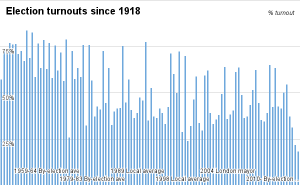
They also have a chart showing that smaller, less nationally important elections get a far lower turnout. Given that their time series data combines all election types, I was curious about how the time series broke down by category.
The first thing to note is that local elections (with lower average turnout) are far more prevalent in recent years, at least in The Guardian’s data. That immediately means that the overall trend will show a decline in turnout, even if turnout within categories hasn’t declined.
Looking at turnout within the major categories gives this:

All of those series could be stationary, save for the by-elections, which show a pretty clear downward trend. The outliers in the local election data are probably just an artifact of the aggregation up to a ‘local’ category.
What I take from this is that trend to lower turnout in the Guardian’s chart is generated largely by the increasing prevalence of local elections, rather than any systematic decline in voter turnout. The interesting question is why voter turnout would be lower when elections are more local. Perhaps some political scientists can help out on that front?
HT: Will Tanner
]]>