Everything boiled down to eligibility criteria – criteria that are intended to exclude those that aren’t deemed to need it.
After realising this, my colleagues and I at e61 were interested in using available data to provide an assessment of the whether these eligibility criteria were effective at this stated aim. So here is the note, and here is the appendix. We also used a similar method to evaluate outcomes for those who did receive the payment.
The key result – judging by consumption responses, there are a group of single Australian’s (likely older and without kids) who appear to go through greater hardship following job loss.
[Update: After setting this post to go up I’ve been sent that the government is going to increase payments for those over 55 – I’m guessing for single individuals. Not the biggest fan of highly bifucated rates, but will wait for the proposal and discuss – and would note that outside of the consumption responses we yarn about the international labour supply evidence on this is quite mixed and hopefully we can comment a bit on Australia in a few months  ]
Before jumping to the post I want to note a couple of things:
- You might believe that irrespective of means this should be a payment for job loss, or a provided minimum income – in this case you’ll still want to scrap criteria no matter what this research says. And that is legitimate.
- You might weigh the costs from individuals missing out much more highly than the provision of a payment to someone who doesn’t need it – in this case you’ll want to dig in further to identify very narrow groups of individuals who may be excluded. This is also legitimate, but the data sources aren’t quite ready to go that deep … yet!
Given this, lets chat.
Eligibility
Given eligibility criteria are largely targeted towards means, it feels relatively simple to just state whether they seem fair or not! There are income and asset tests, and mutual obligation requirements that involve job search components. In this case we’d ask if the income and assets involved in the tests feel like they are at the right level, and whether the cost of job search is appropriate.
This is an important way of looking at the problem, but there is one issue – we can’t observe many of the relative margins where individuals can call on resources to understand how binding this constraint is.
We may observe a low income individual with few assets, but they may have a wealthy family member that helps them through. Or we may observe someone with substantial assets who just cannot access them and is forced into hardship based on insufficient liquidity.
We want to look at a choice that suggests the individual is having to make costly decisions due to the situation they find themselves in – and the choice we can use is their decision about how much they consume.
For a temporary income shock we would expect individuals to try to largely maintain consumption – yes people won’t have to pay for work expenses, and they may be a bit uncertain about future income and so hesitant to spend, but this is the time when people will try to use any access to funds they have to avoid an unnecessarily sharp drop in their spending. We would term this insurance against the income shock.
As JobSeeker is focused on such temporary shocks (where other payments are intended to be for longer term shocks) we can simply ask if people are having to sharply cut consumption when they lose their job. Specifically for eligibility, we can ask if people who do not receive the payment appear to cut spending sharply – as this would imply we are excluding people from the payment, who are not insured against the shock.
How does this look?

At face value there is a drop, so maybe this group isn’t fully insured. But it is hard to tell without a full description of what their optimal behaviour would look like.
The key result instead comes from looking at subgroups – a 3% decline for couples and a 14% decline for single people, when faced with a similar income shock. It is for this reason that we state there appears to be a group of single people who are forced to adjust sharply to job loss, and hence appear to lack the support networks required to maintain consumption.
Adequacy
Given the above way of thinking about the world, we also saw some potential to consider the adequacy of the payment. Static poverty lines are the typical way for looking at adequacy (e.g. this ACOSS-UNSW report) – often augmented with analysis of the assets individuals have on hand.
However, the same choice argument applied above can also be used to think about the consumption choices of those who receive the payment. Right so how’s this look.

So the people receiving the payment cut spending as well – same deal, couples drop 3%, singles 16%. In this way, the payment is inadequate to prevent a drop in spending – and so inadequate purely as an insurance mechanism.
Now it doesn’t follow that the payment rate should rise per se – instead it tells us that there are a group of single individuals who do have to cut their consumption sharply on job loss, even when they receive the benefit payment. Depending on how we view this there are a variety of policies that may be appropriate – a higher payment, an income contingent loan top-up, access to superannuation funds, a levy based income insurance system.
The key point is just that there is this sharp response that is concentrated among a certain group.
Consumption has its own issues
In the appendix to this note we go into a lot more detail about the concerns with using consumption as the measure for considering this. By establishing that the income shocks were similar between recipients and non-recipients, and the expectation of reemployment was similar, we have convinced ourselves that this exercise gives some useful insights about eligibility and adequacy.
Specifically, it is clear that – given the current system and incentives faced – single people respond a lot more to job loss than couples do. Single people, especially those without children, are a perennially ignored group in social policy – even though this is the group that is most of risk of social isolation and in some circumstances poorer labour market outcomes.
In the next few months, we hope to be able to say a bit more about labour market outcomes – and how the benefit system may influence these. But for now, keen for your thoughts in the comment section below!
]]>This is a book review for Thomas Piketty’s “Time for Socialism”. Gulnara got me this for Christmas. I have earlier reviewed Piketty’s magnum opus – Capital in the 21st Century – and will provide a link for that here (review, additional discussion).
Gulnara got me this book because she knew I’d find it interesting – and she also knew that my students are likely to ask me about it. Each year I will have students ask me if we should be communist, whether the profit motivate is immoral, and why we don’t teach the “obvious solutions” to the “clear problems in society”. Every year I appreciate these questions, and the opportunity to think through what these questions mean with the students. As a result, this video is in part my opportunity to prepare.
In the same way as when I chat with my students, the goal here is not to define what is right or wrong in a moral sense – just to look at the arguments at hand and push on them a little, to see where they may be delicate to different evidence or different value judgements. It is only by doing this that we can cut through a group’s rhetoric to have a conversation about what people truly care about. Furthermore, a lot of ground is covered in the book and here – so the discussion should be seen as cursory at best. More detailed discussion of specific issues is something we could do another time.
Gulnara’s section
As with Capital, Time for Socialism is a book that makes arguments that should be aired providing data to establish and support claims. Unlike Capital it is not a long comprehensive book – instead making Piketty’s arguments through five years of newspaper articles that he has written. Sadly this means the arguments are less comprehensively made, and so to make sure we are being fair we’ll have to be quite clear about what we think the argument is before throwing around any criticism.
Both Piketty and the Nolan’s over here are individuals that strongly believe in reducing the inequities in opportunities faced by individuals – and who see economics and justice as inextricably linked. Furthermore, we both believe in the importance of a democratic voice and entrenched rights to allow for this. But even with that framing I feel that we have taken the same goals and come to very different understandings of how this “should” be applied.
Back to Matt
Piketty notes that since his youth in the 1990s he has moved from a strong belief in mainstream economics to what he defines as a more socialist perspective – where socialism is defined as a form of centralised action. This is interesting, as my personal journey has been the complete opposite. In my youth I believed that centralisation and decisions by experts were the elements missing from society, preventing justice and progress – while now I see as many cases, if not more, where it is a lack of belief in individuals to make choices when given the opportunity that holds us all back. Contrary to Piketty’s introductory comments – property rights do play a role in a just society.
While Piketty talks of “the ideal economic system one wishes to set up”, I can’t help but repeat to myself that I do not know what an ideal is – just that I want people to feel secure and capable to make choices and live a good life. Ultimately, my ideal is likely to differ from the ideal of many others – and so I wouldn’t really want to impose that.
No single narrative is right – and these things differ policy by policy – even for Piketty. As a result, the clearest way to understand the book is to describe the arguments given and the facts that support it. Then to discuss what we see as missing from these arguments, and where there are potentially misleading facts. Over to Gulnara to summarise the book.
Gulnara section
Summary:
This book is a series of newspaper articles linked together by common themes. There is no need to evaluate each article or even theme here in order to discuss what needs to be discussed – instead we want to pull together the threads of the worldview noted at the start of the book.
Piketty notes from the start that he wishes to use the term socialism, but that is a term that can have many meanings – for example in New Zealand the term is fairly innocuous for most of us, while in the United States it is loaded with severe negative connotations in much of the public consciousness. He then defines the key characteristics of what he views as socialism to his mind when he uses the term – there are five of these characteristics, listed as:
- Equality of outcomes – with a strong focus on reducing wealth inequality.
- Equality of outcomes and the right to a minimum standard/bundle – this is the provision of goods on an equal basis through government (universal provision).
- Participation through circulation of power and ownership.
- Globalisation – but not as its done now
- Universality and equality
These five characteristics of Piketty’s socialism are the overarching “policy goals” that Piketty is supporting in this text – indicating that they can be widely applied as appropriate rules of thumb in opposition to whatever current policy settings exist. The case and context for this argument is then given throughout the book through multiple newspaper articles – where these tangible specific examples are intended to make a case for these more general points.
Given this, let’s look at each of these a bit more closely and think about a bit of friendly critical evaluation.
Over to Matt
Equality of outcomes and wealth inequality:
To some wealth inequality sounds like the very definition of injustice, while to others even mentioning inequality in wealth is compared to green-eye envy – and I say this as someone with clearly green eyes.
Many years ago I wrote an article in the Dominion Post on how land was socially owned, and we should be willing to pay a rent to government as the representative of society for the use of that land. In this way I feel that I have clearly signalled my own concern that the fruits of land and knowledge may fall in the hands of too few people – and yet I don’t find the discussion in this book of wealth inequality and wealth inequality trends particularly enlightening.
One of the starkest issues with Piketty’s description of wealth inequality is what is missed in the discussion – wealth inequality without considering the change in the age distribution and average age, without describing its relation to the level and allocation of capital resources in an economy, without indicating how the “claim” on that underlying lands production has changed, without considering changes in the risk-free rate and the ability to interpret wealth ratios, and the narrow consideration of financial wealth while excluding the significant build up and use of human capital.
For simplicity let’s come up with a toy example that can help us think through these issues. Take an economy with three people, a capital owner who works and lives in their own factory and two employees who also live and work in the factory. This gives us one capitalist and two workers – even though all three people “feel” the same apart from a property right over the factory.
Furthermore, the gross value added in the production process is then split between capitalists and workers evenly – so 50% of the GVA goes to one person and 50% goes to the two workers. We may look at national accounts figures and say this appears unjust, as there is income inequality – the capitalist receives 50% of the GVA, while the workers receive 25% each. This is inequality in income from the national accounts.
But wait, this is not household income – it does not tell us the amount the individual can consume given their share of the surplus from a production process. Part of the return to our capitalist friend will be used to maintain the usefulness of the capital equipment that is used in production. If we assume that this requires 20% of the total GVA, then their household income is net of this cost of 20% of GVA. So the capitalist receives 30% of the GVA and there is still a little income inequality.
How about wealth inequality? The measure is financial wealth, so it is the associated value of the capital item. This will depend on the present value of the stream of cash flows from the capital item. The additional return (beyond simply selling labour) is 5% of GVA for the capitalist, so the wealth they are holding is the capitalised value of that 5% per year discounted by their discount rate (which is related to the risk-free rate of return).
And the wealth of our workers, well that depends on their saving. But if we assume that people simply spend what they earn there will be no saving – and it makes our example easier. Namely, wealth inequality would be INFINITE.
Which one of these measures refers to our key concern when we discuss inequality of outcomes? I would argue that only the household income inequality measure truly matters – and we would want to understand why inequality in that measure occurs. Is the capitalist taking on more risk? Are they actually providing intangible capital or working longer hours? Or is it purely luck or a matter of initial endowment? Each of these explanations then may give us a different lens on what an appropriate form of redistribution would be.
Piketty’s views differ from this specifically because of his view that wealth itself generates power – and an ability to force redistribution towards yourself. In this world it is not the broad structure of inequality that is the issue – but the density at the very top. It is not truly “wealth inequality” that is the concern – but the ability for the “elites” to claim the resources of society as a whole. The term wealth inequality here is really just a rhetorical device for noting that concern with excessive power – an issue that turns up in a later argument.
Even if we accepted the view on power, we should not forget the coercive nature of the state – governments have to have power to redistribute resources, and that power is in the hands of those who work for the state and elected officials. My article on land ownership that I mentioned before was unpopular with my work, with the newspaper, and with readers – and I realised that my personal views may differ strongly from the views that people hold about the state. I have significant trust in government – probably well above the average.
But taking a step back, I can understand where people are coming from. The government is an institution that can be captured by vested interests, and it isn’t guaranteed that they will always act in the common good.
Furthermore, even with public ownership and the provision of income from that to people in society it is more tangible to point to the provision of a house – the provision of food – or the provision of clean air – than it is to describe the provision of an income that allows individuals to trade-off between things based on their own subjective value.
Trust and security both suggest that individuals themselves value, and are more willing to contribute within, a society with clear property rights that they can share in.
Such an argument does suggest a floor – an ability for someone to live and provide for themselves without reliance on others. It also points to a reservation option if society demands too much from them. But wealth inequality statistics don’t tell us much about that, and if not considered critically can be used to paint a picture of injustice where none exists.
The discussion of wealth inequality is in part a red herring – the true issue is that of a sufficient minimum standard and concerns that institution arrangements and structures lead to regulatory capture and market failure.
Equality of outcomes and rights to a minimum standard – the provision of equal products
Now we can focus explicitly on the discussion of a minimum standard – what does this mean.
Here there are three types of public provision to consider with varying arguments – and which are intrinsically intertwined:
- Underlying absolute needs of the individual.
- Products and services required for equalising the “relative” position of the individual.
- Public goods, products with significant market failures due to asymmetric information, and goods with positive externalities/spillovers.
It is hard not to mix all three, as a single item of government expenditure can embody all of them – i.e. education expenditure.
However, it is important to be clear regarding which of these is the motivation – if you use a market failure argument to state it would clearly be more efficient to spend on this item, but you motivate it using relative position, and fall back on absolute need when pushed, your argument becomes incoherent. At that stage people will start using the “idea” of your argument to push for things in the same way, and given each of these will lead to different observed outcomes your critics will simply pick the argument that appeared to fail in the data to undermine what is being said.
However, I have no experience of these things – I have grown up in New Zealand, born at the start of the fourth Labour government when New Zealand opened up. It is Gulnara that can speak with more authority and experience on the issue of growing up in the Soviet Union where many items were provided by the state.
[Gulnara to talk about her experience here]
Thanks Matt. To my mind there are actually two separate issues here that deserve attention. The first is how pre-distribution was used to achieve “equality of outcomes” and its costs. The second is the post-distribution that occurred in terms of the public provision of products, touching on the issues you have just discussed Matt.
I don’t think we can talk sensibly about one without the other – as the two are linked in terms of how they influence incentives.
Communist Russia progressed from the status of a backward nation to the world’s second-ranking industrial power. Most of this advance was made under a system of tight economic controls which enabled the government to direct investment and labor into development of a heavy industrial base at the expense of other sectors of the economy.
As the Soviet economy became stronger and more complex, the system of central controls became more cumbersome and less able to meet the nation’s needs – output growth started to fall.
Why? Due to the lack of incentives and price signals.
In a number of enterprises the wage rates were fixed in such a way that the difference between the qualified and unqualified, heavy and light work, disappeared almost completely. Equalisation of pay leads to a situation where the unqualified worker does not strive after gaining qualifications, as they do not see any improvement in their personal position.
The fact that wage rates even existed, which was not Lenin’s first desire, indicated that the Soviet Union recognised, it had to work within constraints. But if they could not use markets what other incentive mechanisms could be used. The first solution that was tried were appeals to individual pride. Hunger for prestige was introduced: red labour banners, distinguished scientific, technical and arts worker medals – paired with small material awards added to those honours. This led to increasing status competition to achieve these awards – driving increasing corruption.
During Stalin’s time the need for explicit pay differences was recognised with the difference in pay between the lower and the higher grades of workers increased. From then on those who did not work were seen as parasites and the view of “from everybody according to his ability, to everybody according to his work” was introduced.
However, pay differences never reflected the same difference as was observed in the Western world. Why? Because of underlying public provision associated with roles. The Soviet Union used direct ownership and provision of goods and services as a way of remunerating staff – and the big difference between this and other forms of remuneration was that it was non-transparent. Such non-transparency drove corruption, with a culture of corruption leaching into everything that occured.
The Soviet system did provide you with your minimum needs such as housing and effortless access to the job market, and hence a minimum income as long as you were able to do the job you were told.
However, if you had talents and skills and wanted to use them to progress, this was not possible. Nation-wide corruption was prominent. In education for example, you had a chance to study hard and get into university, but say you had 5 places allocated to engineering in a given year, 3-4 of them would be already taken by some (e.g. a prosecutor or mayor’s child), leaving hundreds of students to compete for 1 single place. Similar things would be observed in allocations of prestigious jobs such as medical doctors, university lecturers, and more higher up in the hierarchy jobs (mayors, lawyers, head of any departments). The blockage of access to any of this sort of incentives, led to a lost opportunities of talents. It was almost impossible to get into positions you were striving for if you didn’t have any relative, friend who could pretty much sort it out for you.
This happened with everything – better housing would go to people based on who they know, better jobs would go to people who were better at socialising, and better schools would be available to those who got on well with the university.
I have personal examples, but I feel uncomfortable mentioning them. Ultimately, for all its imperfections, outcomes in the West bear some relation to effort – and that link is essential for any sort of trust in society. Public provision can be just as corrosive as entrenched private sector inequality – and this is a trade-off that Piketty often misses.
[Back to Matt]
This does lead to a question though – why is Piketty focused on government provision of these goods and services, and not government provision of the income necessary to buy these goods and services with private provision?
There can be good reasons for public provision – market failures stemming from asymmetric information, competition issues, institutional issues, and spillovers or externalities. Relatedly, the broader inability for individuals to pool risk and the belief in a given minimum living standard for all individuals may motivate public provision – although it is more likely to motivate direct income support. Behavioural economics may come in and state that individuals will not purchase things that are in their own interest.
Finally, but differently to above, there may be a social reason for believing that everyone should receive the same product – in order to enshrine some conception of equality of opportunity, or to engender a sense of shared experience between individuals.
However, this does lead to three concerns we may have about such provision:
- Inefficiency: The traditional “inefficiency of public provision” – the idea that civil servants, unencumbered by the discipline of competition, would extract surplus for themselves by working less. More broadly, we have the incentive issues Gulnara noted earlier.
- Consistency with other measures: The interpretation of income and wealth inequality statistics may change – if we take our toy example from before, if we know that a government was providing education, food, housing, toilet paper, and roads would we feel differently about the inequality of income and wealth than if it was not? Final income studies try to account for this, but they are fairly rare and often allocate expenditure in an ad hoc or subjective manner (i.e. Harding. Lloyd & Warren 2006: The Distributional Effects of Government Spending and Taxation | Levy Economics Institute (levyinstitute.org), Auten Splinter 2019 AutenSplinter-Tax_Data_and_Inequality.pdf (davidsplinter.com), and Saez Zucman 2020 w27922.auto.pdf (berkeley.edu))
- Preference heterogeneity and choice: It sounds nice to provide things to people, but there are two issues that come up.
- The obvious one is that people may value things differently, and so providing something without choice may simply mean the people don’t get what they most desire – they no longer have a choice about the type of health care or education. Here we would have inefficiency in terms of how inputs create social welfare.
- But there is a second issue – how do you operationalise provision? Everyone has different educational opportunities because their parents will spend a different amount of time studying with them. Focusing only on equality of the provision of education led Piketty to bemoan school choice in “Inequality in France” and “Parcoursup: Could Do Better”, but what happens if the same argument then led us to say that all children should go to a boarding school to remove unequal opportunities. Is such a dictate from above truly just? What about a dictate that the same school materials should be used? What about if the children were banned from going home for the holiday to promote equality? What about if the children were taken at birth to prevent any parental based advantage – where do views of individual rights become sufficient for us to say no, and how could they be included in the argument?
All I can really say for this section is that measures of expenditure are essential for understanding outcomes – and we should be careful trying to be too dogmatic one way or the other. To go any deeper would require an additional hour for this video.
Sharing of power
Piketty’s focus on power sharing is two-fold:
- Sharing power within a firm through increased employee ownership and voting rights.
- Sharing power within society through greater taxation on wealth and inheritance and the provision of a minimum “capital payment” to all individuals.
Let’s start with the first point. Why is tying an employee to an organisation the way we want to address any imbalance between the employer and employee power? In the articles “Basic Income or Fair Wage” and “Rethinking the Capital Code” Piketty makes clear that it is unfair bargaining positions that he is interested in addressing with employee ownership schemes – although there are a number of OECD papers now linking these schemes to productivity and wage gains from such firms, his focus is rightly on the issue at hand given the likely selection bias issues in a number of these studies.
Maybe it is the New Zealander in me talking, but the ability to cleanly move between jobs, contribute to different projects, and move to whatever task appears to need me most is something that is positive – and rules that assume and enforce a situation where people have to stay tied to one job seems wrong on both a social and an individual level.
As our toy example earlier noted, it was the combination of employees and an employer that generated the GVA, which was then split between the individuals. The ability for the employee to force a move away helps to give them the position to bargain a higher share of that surplus, the employer and employees incentive to maintain and build capital (physical and human) similarly creates the surplus that is shared. If joint ownership helped them to do both, and they are both in a position of power, it does not seem necessary to dictate joint ownership – and such dictates appear to be blunt tools.
Furthermore, such dictates may have unintended consequences – they link an employee with a firm potentially reducing their outside options, they make the employee more exposed to shocks facing the firm, and they make the retirement savings of the individual less diversified. Ignoring any costs to capitalists even from a pure workers perspective there are significant shortcomings to work through.
This is not to say there is no room for equalising bargaining positions, and for improving employee rights in the face of monopsony and asymmetric information. And mobility itself is not costless – the loss of firm specific capital and the insecurity associated with job movement and job fragility are all real. But labour laws and fundamental income support appear to be a way to address this without the individual being tied to the business.
The minimum capital payment is something that fits strongly within the narrative we’ve been supportive about above. The incomes we all earn, and the returns on our assets, are in part due to the fact we are in a high productivity world – rather than just a product of the sweat of our brow. In such a case, ensuring that everyone starts off with something feels consistent.
Similarly, recent research by Balboni etal 2021 indicates the importance of available capital for helping individuals get out of poverty traps. https://twitter.com/ChaseReid5/status/1474894957190295559
But let’s be clear on how things are being financed. A decision to finance this with a wealth tax is increasing the cost of capital, and will in turn reduce investment. We may see that as appropriate, we may see this as preferable to alternative forms of financing, but there will be a change in behaviour.
Why is it that people who accumulate should be liable to pay more tax than those who have the same income, but just love spending more? What is the actual “social dividend” that is captured in transactions between individuals, and why is it not that figure that we are reallocating? Given that, government revenues and expenditures are then how this claim is actioned.
It is here that Piketty’s argument is weak – to raise the funds for the type of capital redistribution required we would require everyone to contribute on the basis of their share of this boon of productivity, the mechanism of a wealth tax (which I’d take as a de facto more progressive tax scale) is not sufficient. Whether you take the revenue estimates of Sarin and Summer or Saez and Zucman saez-zucman-responseto-summers-sarin.pdf (gabriel-zucman.eu) – the higher of which Piketty cites in “Wealth Tax in America” – such a tax at rates that create a tax liability greater than the income flow would not be sufficient to fund the redistribution discussed – and would be well below the Sarin Summers estimates of improved broad tax enforcement Understanding the Revenue Potential of Tax Compliance Investment | NBER.
The comparison to history here is a red herring, again. Government expenditures to GDP are now higher in most countries than they were at any time in the past, and are financed through broad funding measures. Piketty believes in greater expenditures than in the past and that will require greater funding than in the past, with the consequences that creates – there is nothing wrong with believing in that, but we need to be clear on the trade-offs.
If the implied tax on income earned from an asset rose towards 100%, people would switch from considering how to avoid tax more than how to effectively utilise the asset – and marginal discussions of how UCC changes would influence the capital stock, as Gulnara and myself had undertaken earlier in the year Taxation, user cost of capital and investment behaviour of New Zealand firms (vuw.ac.nz), would not give us an accurate picture of this.
And this is the crux of the debate – government expenditures and transfers, along with taxation, is how the “minimum capital payment” is operationalised now. The fact I can use a public road, go to the hospital for a nominal fee, and sit in a park all indicate that there is a type of “minimum capital payment” already. The questions that separate people are “how large should it be” “who should contribute to it” and “who gets to choose how the capital is allocated”.
Globalisation and universality
The last two options we’ll put together into one and only discuss briefly. Although there is the odd bit of rhetoric in there that globe twitter may disagree with – the basis for both these sections is for global equality and anonymity for the treatment of people, which are essentially globes goals. The guiding principle of any governance institution, or any supra-national organisation, should be to ensure equal treatment of individuals and support for minimum standards – where these standards of equality correct for differences in opportunity based on gender and ethnicity.
Just like the majority of economists including us, his view may read as naive for those from both the left and right – who believe in the moral imperative of some cultural or social arrangement, that some differences are “natural” or “necessary”, or that it is practically impossible for such coordination to occur.
Personally I find it refreshing. When we look back to now in 100 years it would be our willingness to accept poverty in low income nations that would lead our great grandchildren to view us as immoral – not the fact that someone once said something inappropriate on twitter. The fact that the left and the right can only see injustice insofar as it relates to them or their peer group – and not through our global refusal to support those most in need – is such a clear failure in public discourse that on these points I have no real area for disagreement with Piketty.
Articles such as “Europe, Migrants, and Trade” and “Manifesto for the Democratization of Europe” also indicate that Piketty also sees the inclusion and integration of migrants as part of this overall program – showing a consistency that an increasing number of economists are losing in recent years.
Where this view of equality does create disagreement is with how others will interpret Piketty – and sometimes how he interprets himself in the newspaper articles. In a tweet from Noah Smith he notes:
 on Twitter: “In which @BrankoMilan argues (correctly) that the people complaining about capitalism are almost exclusively people in rich Western countries where capitalist globalization has caused the disappointment of the middle classes.

Is the injustice here that some middle class Americans have seen income growth stall – as it is Americans, not other high income countries. Or is it the level of poverty in low income countries? The idea that if the wealthy simply had less wealth then both the global poor and middle class would have been better off is simply not true – those with wealth are those who built and allocated capital in such a way that it helped to lift the truly poor out of poverty, to their own interest. Reallocating from the most wealth alone would not generate the revenues necessary for the global expenditures Piketty suggests, and yet this is what he appears to indicate from the very first of his newspaper articles.
Why do I raise this – Piketty cites an earlier version of this very graphic in “After Climate Denial, Inequality Denial”, but all he states in the article is that this graph makes the case for the inequalities he bemoans and that others that view it differently (such as the Economist magazine) are being dishonest. This is not right. To argue from data we need a counterfactual, and acting as if this is a fixed sum of income to be reallocated is a likely poor counterfactual – asking “why” is important, as fits the idea that debate is kept open which is what he asks for in the first chapter of this book.
Questioning this also opens other doors that he may have inadvertently shut – market power and concentration of firms, regulatory capture, unequal international treaties. All these issues can offer explanations for the distribution of income and wealth that suggest policy conclusions that differ from expenditure and revenue raising. Understanding “why” is important for knowing what intervention is truly just.
In this way, the rhetoric is inconsistent – picking and choosing the cause in isolation based on the subject of the article. The honest interpretation that everyone who has benefited from technological growth over a long period of time would need to contribute to support his redistributive grand-design is missing. And that where income change is not the product of technological growth, but instead power, we need to understand the power dynamic prior to considering the intervention. If someone has power due to concentration or regulatory capture, they will have the means to avoid indirect instruments such as a tax.
Conclusion remark
Also, I will say one more thing about the arguments overall – after all the road to hell is paved with good intentions. Within any structure, institution, and society it is always the way that the “needs of the many” can swamp the “needs of the few”. Or even the wants of the many can swamp the absolute needs of the few.
We all have varying conceptions of justice due to different perspectives, different preferences, and different beliefs. And the tyranny of the majority is a real thing, that becomes strongest when change is driven in the name of justice and victory over some other.
The principles of universality and equality work only when the rights of the individual are enshrined and protected – and every single time we think of a neat scheme to improve some metrics of outcomes we need to keep that in mind. This isn’t some way to slow down progress – it is a way to stop our generation from becoming the monsters we read about in history books.
A desire to do good needs to be balanced alongside humility and a recognition that we don’t always know what good is – if we lose sight of that we might lose the argument, but even worse we might win it.
]]>Given the excitement around these methods, Chicago University has recently run the IGM Economic Experts Panel asking economic experts on whether the “ Randomized control trials are a valuable tool for making significant progress in poverty reduction”. The results of the poll are summarized in the graph below.
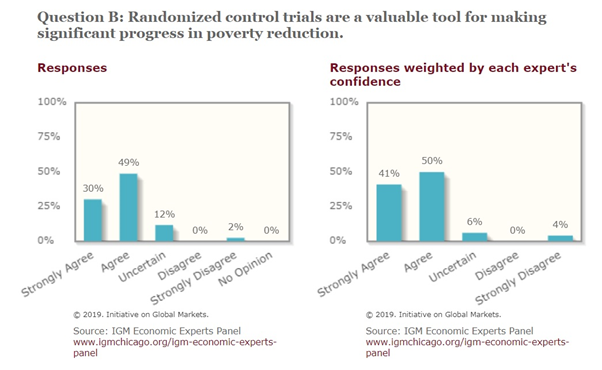
The chart above highlights respondents’ agreement distribution. What struck me most from the results was Angus Deaton’s strong disagreement with the statement – especially given that he is an expert in the field.
Why does Deaton strongly disagree?
To answer that we would like to think about what the RCT is and how does it fit to answer the policy question. Let’s shed some light on it.
What is an RCT?
RCT is a technique used predominantly in medical sciences, but also applied in economics quite intensively , especially in the last few decades. The technique works in the following way. Researchers randomly select a group of people to allocate them a clinical intervention (such as an anti-cancer pill). The comparison group (which is called the control group) is also randomly selected where they received a placebo intervention (such as a sugar pill).
Then the researchers compare the difference between the groups to quantify the significance of the treatment (clinical intervention or “treatment effect”).
In economic research, RCT is often applied in poverty alleviation schemes to help quantify the effect of the policy intervention. However, it has been applied much more widely giving insights about the labour market, behavioural economics, health economics, taxation, and industrial economics.
So an RCT tells me what a policy does?
RCT gives us an empirical treatment effect given specific conditions. This is the type of thing economists will often call a stylised fact.
However, stylised facts cannot give us general policy effects – they tell us what the policy response was in a specific set of circumstances, but we need to be able to generalize that effect to apply it in other circumstances.
This is where Deaton gets concerned, and where some of the push-back against RCT stems from.
To get a policy effect we still need a model – simply scaling up an RCT involves imposing an implicit model about how the policy and behavioural responses work, one that assumes the scale of the policy change does not matter and that there are no general equilibrium effects.
This matters. If we provided a minimum income payment in Treviso, Italy we may find certain changes in prices and labour supply responses in that community. However, we could not then take that result and “scale it up” across Italy as a whole – as Treviso was not a closed system in the same way an entire country may be, and the larger scale of the policy would influence prices and labour market responses differently as a result (eg if a minimum income increased demand for particular goods, doing so in a small region may not change the price for that good – while doing it for the whole country would).
How economic models fit in here?
Economic models provide the mechanism for generating generalisability. At the same time, models and RCT results should work in a recipricotive way.
Given the same conditions as the RCT, a good economic model should be able to replicate the result – or at least key attributes of it. Given the ability to replicate an RCT for those conditions, the model then embeds key assumptions about why that result held and a description of the systems that make up the question at hand – this allows an economist to ask counterfactual questions about what would happen if the policy introduced was much larger.
However, it isn’t all one way. Models should in turn be reevaluated if a robust body of RCT evidence suggests that – for a given set of conditions – the models results are false. RCTs provide the pieces of evidence that models should be able to replicate, while models provide a framework for understanding what can’t be measured and how other, counterfactual, policy changes will work.
Examples of policy implementations (treatments):
To clarify let’s talk about specific examples of how the RCT can be used.
Minimum wage and labour market
Let’s consider an example with minimum wage increase and the labour market outcomes. Card and Kruger (1993) found that the minimum wage increase in New Jersey led to employment increases in the state compared to the other state (Pennsylvania), where the same policy was not applied.
Now if we want to take this result and generalise it to the population level, saying that if we increase minimum wage, it will lead to an increase in employment rate, we are making a mistake. Why? Because the same increase in the minimum wage in all states would have different impacts due to the composition of those states, the overall change in prices in the economy, and the capital structure and industries that are viable across the US economy.
However, it showed there were real shortcomings with models that could ONLY indicate that an increase in the minimum wage could reduce employment. This helped to generate a literature that has more carefully considered the role of minimum wages given the potential for market power and strategic interaction in the market for low wage workers.
What is the solution then?
In Deaton’s view too much is being asked of RCTs, and indeed people need to recognise how to “transport” the results to another context:
“More generally, demonstrating that a treatment works in one situation is exceedingly weak evidence that it will work in the same way elsewhere; this is the ‘transportation’ problem: what does it take to allow us to use the results in new contexts, whether policy contexts or in the development of theory?
It can only be addressed by using previous knowledge and understanding, i.e. by interpreting the RCT within some structure, the structure that, somewhat paradoxically, the RCT gets its credibility from refusing to use. If we want to go from an RCT to policy, we need to build a bridge from the RCT to the policy.”
Deaton’s concern, which is reasonable, is that RCTs are treated as a sole source of truth. But such a focus isn’t just misleading, it would be bad science.
Card and Kruger’s paper did not tell us that a higher minimum wage would increase employment – it taught us that reality is complicated, and the evaluation of policy must be based on trying to understand how this works, using both evidence and theory. Duflo, Kremer, and Banerjee similarly see the importance of both – in her Economist as Plumber article Duflo notes:
“However, because the economist-plumber intervenes in the real world, she has a responsibility to assess the effects of whatever manipulation she was involved with, as rigorously as possible, and help correct the course: the economist-plumber needs to persistently experiment, and repeat the cycle of trying something out, observing, tinkering, trying again”
Deaton’s concern is that people will experiment and measure without ever trying to model and understand what they are doing – thereby generating a stream of published studies but no understanding. Those that are more positive about the RCT revolution instead see such experimentation as part of this very iterative process that helps to describe the “transport” problem that Deaton is concerned about.
To sum it up
Predicting a policy result from a given policy involves an implicit model – irrespective of the number of RCTs that have been run. However, these RCT provide a discipline that any worthwhile predictive model needs to be able to replicate – they provide the true stylised facts (if done properly) that a predictive model must match to be credible.
]]>One of the true tests of a society is measured by how it treats its most vulnerable members, particularly the old, the young, the sick, and the disabled. There is a lot of good with New Zealand and New Zealand policy. However, on assisting those unable to provide for themselves, our provisions for people unable to work due to a health condition is an area where we are increasingly failing.
In 2018, 92,500 people were receiving a supported living payment (SLP), [1] making up 1.9% of the population, compared with 15.5% of the population receiving superannuation. Yet over time the amount paid to those receiving the SLP has steadily declined relative to both wages and other benefit payments like superannuation.
This article outlines why the SLP needs to rise drastically and concludes that we need to honestly evaluate whether we are giving those who are excluded from the labour market the opportunity to live a meaningful life.
Some back-of-the-envelope calculations show it would cost $633m per year to align SLPs with superannuation rates – a cost dwarfed by the $13b spent on superannuation alone in 2018. With the Welfare Expert Advisory Group report expected to be released soon, addressing this unequal treatment should be high on their priority list.
Some background on supported living payments
The passing of the Social Security Act in 1938 established the modern benefit system we still see broadly today, with a version of superannuation and the supported living payment (SLP) introduced. At the time, both offered the same payment rate. The justification for this was clear from the description in the Act and the corresponding description of the 1898 Old-age Pensions Act – if you cannot work permanently, society will give you the funds to enjoy a minimum standard of living.
Over time the tax treatment and eligibility for superannuation and SLP payments changed. But the principle that the base payment of both would remain the same was followed until the early 1990s.
The 1991 Budget (the Mother of All Budgets) saw a series of benefit cuts, some by as much at 25%. [2] However, as SLP benefits and superannuation were justified based on need, the government refused to cut them.
Instead, other attributes of superannuation and disability payments were changed (for example the eligibility age for superannuation, and how benefit payments were actually provided to recipients).
A new payment for superannuitants living alone was introduced – which was the reason for the 1992 decline in the ratio (see Graph 1). As part of these reforms, additional support to those with specific needs was intended to be provided through targeting supplementary benefit payments.
However, the reality has been that supplementary and special assistance can be hard and costly to access, and social welfare organisations have been designed to make this more difficult given the disproportionate fear of “welfare bludgers” – a concept which is considerably difficult to comprehend for those shown to be unable to work due to health conditions.
Disability payments fall behind other supported communities
Over time, SLPs have significantly declined relative to superannuation payments (see Graph 1). In 1990, SLPs for a single person were 105% of the single-person superannuation rate.
Graph 1

Ten years later in 1999, the single-person SLP was just below the single-person superannuation rate (at 94%). It has slipped even further since, to 83% of the single-person superannuation rate in 2010, and in 2019 is currently worth just 73% of the single-person superannuation rate.
Superannuation keeps pace with wages, but disability payments fall
Over time, supported living payments have also declined as a proportion of average weekly wages. This decline has occurred even as superannuation payments have remained a steady proportion of average weekly wages. Having SLPs decline relative to the average weekly wage indicates that although workers and superannuitants have maintained a similar trend of living quality, those physically unable to work have seen the funds they receive dwindle lower even as costs increase.
Over the past thirty years, SLPs have declined from 33% of the average weekly wage in 1989 to 26% in 2018 – a eight percentage point decrease (see Graph 2).
Graph 2

Over the same period, superannuation as a proportion of the average wage has actually increased, from 32% in 1989 to 37% in 2018 – a five percentage point increase.
It should be noted that there are added payments that someone can receive through the benefit system based on need, including the Accommodation Supplement, disability payments for regular health costs, special disability payments, and the community services card.
However, these additions can be accessed by someone on superannuation as well as the SLP – hence why the disparity in base payment rates is uniquely unfair. Furthermore, these additional payments don’t necessarily get provided to those in need .
Supported living payments must rise to protect those unable to work
This divergence in benefit payments to the old and the disabled implies that the support society should provide to the old is greater than the support for the disabled – a sad reflection when previously society valued both similarly in recognition that they could not work themselves.
That’s not to say that those receiving superannuation should receive less (that’s a totally separate aspect), but instead that those unable to work due to health conditions should be paid at a similar if not the same rate as superannuation.
It’s also important to point out that there are many different views about whether certain minimum incomes (like superannuation or supported living payments) are sufficient or not for individuals. But given we commonly discuss superannuation as a “top-up” to a retiree’s income, and that it would be difficult to get by on superannuation payments alone, it’s highly concerning that New Zealand provides a much lower payment to those unable to work due to health conditions.
Someone who has had an entire working life to save income for their retirement may have been unable to or may have faced difficult circumstances and hence deserve our support. That’s not at question. But someone suffering from a disability that keeps them permanently out of the labour market has, at most, a limited opportunity to access the labour market to try to gain income for their livelihood. This lack of opportunity justifies why someone receiving a supported living payment should be paid at least the same if not more than the superannuation rate – not less.
To be clear, receiving a supported living payment isn’t a case of someone avoiding work. Work testing for this benefit must occur every two years, even though they also need to show the condition is keeping them permanently out of work. For those who receive SLP, the lower payments are probably not the most important issue they struggle with –when many people receiving this payment want the opportunity to be involved in the labour market, want fair payment for those who support them (especially family members), and are concerned about negative social treatment due to their condition. But treating these people in the same way we treat others would be a start.
As a society, we value the idea that we give people the same opportunity to live a good life. When someone is dealt a rough hand, as a community we should do more to support them. Our willingness to let payments to those with disabilities decline relative to those on superannuation and relative to the average wage indicates either a lack of empathy, or an inadvertent hypocrisy in terms of the way we have established our support for those unable to work themselves.
It seems only right that we correct the unequal benefit payments, starting by increasing supported living payments to the same level as superannuation, and then keeping payments in line with superannuation and wage rises.
]]>He answered that they wouldn’t, and went on about something – but in truth it is because of his definition of “same” with regards to the model he was describing. He was looking at a GE model with people with the “same” endowments and preferences – and yeah sure in that model there is no trade with highest 1:500 leverage. But this ignores the idea of production entirely – even if we have the same preferences and same “characteristics” (in terms of the hours we are endowed with and our ability to turn those into leisure or output), the existence of a production process with specialisation implies that there is benefit from specialising and then trading. This division of labour is pretty central to our understanding of trade, so we shouldn’t really look past it.
But it raises something important as well. We need to describe why people are trading, and what exactly is driving that process, before we can evaluate anything. Let’s make a quick framework that will help us do that!
Why are we trading then?
Ok, we trade for one reason – someone who has something values it less than someone who buys it [Note: Those explanations of value in the Wikipedia article are atrocious – the description at the top is what I’m linking to]. This says nothing of the process that leads to these relative values, or the harm or benefit that trade may have on other people uninvolved in the transaction. All it tells us is that these differences in value give the reason for trade.
If there are three of us sitting around, there are 9 chocolate bars (3 Moros, 3 Mars bars, and 3 Snickers), and we all value varying chocolate bars the same way (a Moro, Mars bar, and Snickers each give us the same level of utility, but we also have the same type of diminishing marginal utility from either) then we can think about trade. If we are each endowed with 1 of each bar we will not trade. If we are each endowed with 3 of one bar, then there are gains from trade – and a trade with equal bargaining power will see us go from an endowment of 3 of 1 chocolate bar to having 1 of each of the 3 chocolate bars!
Now if there is production, the existence of the division of labour suggests we can make more by focusing on only making one thing – or one element of one thing. Given this we are paid money incomes which we can use to trade with other people specialising. Our decision to work gives us money incomes, we then trade these money incomes for products from the firms that organised us blah blah blah. The key thing is NOTHING here requires that people are different – instead people are doing different things because of the institutional structure of the economy alone.
How can we be different in ways that may cause trade without specialisation though? There are three ways:
- We have different preferences over things (goods and services, leisure, chocolate bars) – we differ in how we turn the observed products, and the endowment of hours we have which we spend on “leisure/home production”, into utility.
- We have varying abilities to turn our time into goods and services, both in a relative sense (what am I good at making?) and an absolute sense – we differ in terms of how we turn our endowment of hours that are spent on remunerated work into products. [Note: I state products rather than incomes, as the income we are remunerated with for producing may in turn vary from our contribution to output due to institutional structure.]
- We vary in terms of our non-income generating and non-utility from consumption generating characteristics – what we commonly think of as “endowments”, even though our preferences and ability to work are also endowments in a sense. Think here the wealth we start off with when we are born, or start off in a society where there is a safety net so we don’t face the risk of starvation. However, to get that trade the endowment must vary from the set of things that the individual values … that is the example of clustered chocolate bars before.
Ok that is nice, we have extra reasons why we may observe trade. But are patterns of trade fair?
Are patterns of trade fair?
So here we can try another framework. Why might we get different outcomes?
- If everyone is exactly the same and we have different outcomes, then this appears unjust.
- If peoples preferences differ and we have different outcomes then we don’t know – if we have equal outcomes this is unjust.
- If some people are better at making things then others and we have different outcomes then we don’t know – if we have equal outcomes then we don’t know either.
We can start to see some threads coming through if we can agree with the above statements. Horizontal equity appears as, since everyone is exactly the same varying outcomes solely imply differential treatment by society.
With the second one things are difficult. People actually enjoy different things and make different choices. Some people like to work and consume, some people despise working and don’t value consumption much – these people are allowed to make different choices. Forcing people who want to do different things to do the same thing is unjust.
The last one is where things get difficult. We need to ask “why are some people better at making some things than others”? Are they endowed with natural talents? If so, they are endowed with something by luck that is giving them higher life satisfaction – is that fair? If not is it the responsibility of government to make it fair? If so what will happen to the behaviour of this person if we reduce the income they receive from doing that production – will they decide to work less or take more leisure?
What happens if, instead of natural talents we are talking about someone who undertook extra training, or someone who has been in the labour force longer … how do our answers change as the REASON for the difference changes!
In this last example we get a lot of the trade-offs that we argue about when discussing policy all the time – is redistribution just? Even if it is just in terms of distribution, what about if it leads to less being produced overall?
This can lead to the argument regarding deserving vs undeserving poor – someone with a lifetime disability as compared to someone who could work but sits around playing Fifa 19.
Importantly, how do our answers change once we shift the question to why people may make a higher income from their role – is that solely the response of them creating more, or is there something to do with the institutional structure. What happens if, as a white man, I am just paid more than a different group?
As soon as we introduce heterogeneity we find that some inequality is actually good, but we also find that types of injustices differ greatly based on the differences between people – something that is incredibly important and gets ignored when some loud mouth like me makes a statement like “replace the minimum wage with a minimum income“. Policies have different ethical principles embedded in them, and we should be trying to ask about those when we decide what types of policies we support in a society like New Zealand.
This is why I’m an incrementalist – instead of trying to grab a measure of wellbeing and maximising it, I’d prefer we try to figure out what equity/fairness principles are relevant to people in society, and to ask what the policy trade-offs would be when trying to correct for observed injustices. My unpopular opinion among many economists is that a lot of New Zealand’s policy settings are actually pretty good when we ask these sorts of questions … hence why incremental change rather than some type of Big Kahuna is appropriate where we are at the moment.
Although if you want to disagree with me in comments, and provide some arguments why, I’d enjoy it
One thing I keep hearing, repeatedly, about a centre-Green party is that it doesn’t make sense because it involves hating people. I hear the same thing about anything people don’t agree with, repeatedly. Emails, phone calls, on twitter – for some reason people want to tell me how much other people hate people, and so they hate people or me or something. I don’t know, whenever I hear blind hate it never makes much sense to me – but certain comments have pushed me into a rant. It is a blog, these things happen sometimes, sorry.
The short version of my post is that the people saying this are disrespectful individuals who have no respect for other people and the difficulty of issues of social justice. But if you want the full rant click below (and it is a furious rant with more colourful language). For those who dislike rants (as do I), you could read this old post where I lay out a neat discussion of why social justice issues are core to all parts of the political spectrum, the focuses on “types” of injustice is what differs.
The type of attitude I’m complaining about is embodied in this tweet [Note: I’m not linking to the tweet – only putting in the text, as I don’t want it to be targeted at an individual at all]:
‘Blue Greens’ are really just people who care about the environment but don’t give a toss about the people living in it.
Now this is far from the only tweet of this type I’ve seen, I just saw this as an extreme example. I also don’t want to pick on the author specifically here (in case someone recognises the tweet) – they appear to discuss things later on in the chain, and appear to be an intelligent and good person. I have seen similar comments from a LARGE number of the people on twitter and have no doubt that there are many people making these comments as it represents how they feel.
Furthermore, I’m all for people disagreeing with what is “right” policy . Debate, protest, discussion – important stuff. Those people saying that they wouldn’t want a centre-Green party, that it doesn’t fit their belief system, that they don’t think there are votes in it are mentioning important points – points I definitely relate to.
Finally, I really want to reach out and have a discussion with the people making these types of comments – rather than alienating them in a passionate rant.
But … to be honest this specific comment and its ilk is this sort of rubbish that convinces many New Zealanders that the left are arrogant self-righteous “social justice warriors”*. And legitimately, as long as a lot of people on the left are making these types of comments about other New Zealanders, then a lot of the vocal NZ left are arrogant self-righteous social justice warriors.
Saying that people who disagree that a given set of policies are what is “fair and just” don’t care about people makes me furious – it is a form of argument that I find insulting, and a type of argument the exudes an elitist arrogance which makes me show physical signs of anger. How dare you accuse other people of not caring about our society just because their views differ to yours, what gives anyone the right to claim something like this – it makes me so furious that my anger is palpable!
I grew up with, and still spend time with, these types of Social Justice Warriors/Chardonnay Socialists/Craft Beer Communists. I appreciate hearing their thoughts on social issues and their wrestling with injustice. But I refuse to control my seething distaste for the comments I often here from this group when someone disagrees with them – it is NOT OK to say others do not care about people.
If you make this kind of comment we have issues – I have all the time in the world for discussions about different value judgments, but as soon as you try to paint “others” as not caring about people while you do, you’ve crossed a very clear line with me. And it is not just the word – but the very intention of it, if this is something you fundamentally believe we have … a problem.
Calm down it’s ok – we can tell you’re annoyed
Let me try to clarify this by getting back to point. Now I’ve discussed the logic behind a left-Green and centre-Green in terms of ideas of sustainability here – if the current social system is perceived as “sustainable” (which embodies some view on fairness captured in the way we consider social outcomes) then these types of sustainability issues will not deserve as much weight as issues of natural sustainability (eg the environment). In many ways a lot of New Zealander’s may well see society as fair, may believe that society is as fair as government policy could allow (given it can’t solve every injustice without creating greater injustices), or may at least believe that the policies being pushed by the parties on the left are not consistent with their idea of fairness.
Too have a left we need to admit left is relative, this is relative to the NZ consensus, who I also see as the boss. In this context a “centre-Green” party merely accepts the current consensus policy on economic issues, while focusing on change relative to environmental issues. It is genuinely that simple. Saying that it involves “immoral” choices on current economic/financial policy is akin to saying that only the left has a moral mandate – holy cr*p if that is your view then arrogant was totally the right term!
Now how do I view “left” if we were to shift from centre. The left-right spectrum all has room for evidence around trade-offs that exist, but differs in terms of the trade-offs they are willing to make – where the trade-offs are often policy specific, but boil down to a series of discussions about redistribution. A clear example is a guaranteed minimum income – in that case someone who is economically left would support a higher minimum payment, and higher tax rates, than someone who is economically right.
But that was too simple, what about other policy questions! Well in terms of “economic left and right” other questions get really hard to put on such a simple spectrum – to do this I often need to consider where we set boundaries on equality of opportunity, someone to the left will tend to set the “opportunity” bar very differently to someone much further to the right. Here the lines get fuzzy with other dimensions policy can differ on namely social and environmental, and everything within them, but the key point with all of them is that the vast majority of people forming a view over this policy space are doing so given their perspective, and an interest of the people living in society with them.
One of the key things people may not realise reading this rant is that I self-identify as economically left (not centre left, left). Not in terms of the Nolan chart definition of unweighted questions, but in terms of the scale of redistribution and the type of redistribution (through social provision of types of services). I try to leave it out of the blog, but it is relevant for this rant.
I do not see many of the policies of the left as particularly left-wing when viewed analytically – the language I use is that they are “rhetorically” left wing rather than “functionally” (in terms of redistributive outcomes) left wing.
For example, given the current tax-benefit system the minimum wage hikes that are being discussed threaten to exclude the vulnerable in society from the labour market, while providing little income for the “households with children” that are supposedly being targeted. If the left genuinely cared about individuals, the actual outcomes of their policies would matter rather than how well they think their policy rhetoric sells their appeal to other social justice warriors – and in that situation I wouldn’t find myself suggesting, as I did pre-election, that National was (in terms of focusing on genuine outcomes and opportunities – rather than just rhetoric) in some ways left of Labour.
I would support the policies of a left-Green party (if they represented what I see as left) above a centre-Green party. But I would more likely vote for the centre-Green party due to their ability to work with either side – and thereby get traction on environmental issues. This is just me, and the rest of the universe thinks about things differently – but their is no need for us to throw around names about people who think differently than us!
Do you have a general point, you’ve just been talking about this boring Green stuff again …
How many people who accuse the “other side” of not caring about people have actually tried to understand the other sides argument? How many have actually gone through detailed empirical policy work trying to understand what trade-offs exist, and trying to figure out what we can know about social issues? I tell you what it is a lot of work to do and no-one has the hours in the day – but I find it amazing anyone can have such a negative view of others intentions after doing all this work, let alone before doing it.
If you think the other side is “evil” please, try to figure out what their argument is first and discuss with them – if they won’t, that is their flaw, but often they will! At the end you may agree to disagree (value judgments may differ) but it will allow you both to work out whether your definitions are the same and to share evidence.
If instead you think “right” policy is “self-evident” you are a moron – true story.
(the prior quote) reinforces, in my mind, why I am fatigued from seeing people claim the ‘labels’ of freedom, social capital, and egalitarianism. Instead we should be honestly discussing our views on what is morally important and what trade-offs exist.
For many people out there writing on blogs and tweeting they are certain that their argument is what is essentially morally right – but I argue that you have a moral obligation to try and view your opponents argument in the best possible light, and to figure out why you differ. Virtually no-one out there is supporting things which they believe are “unfair”, and by forcing yourself to understand their argument you learn more about your own views.
We all want and desire to help make the world a better place. But we only do this by reaching some form of moral consensus between us, and a relative willingness to admit and deal with trade-offs – not by labeling people who disagree with our judgments as something relatively meaningless (neo-liberal, communist, Nazi) and ignoring their views. Instead of labeling ourselves as focused solely on the basis of one factor we likely can’t explain (such as inequality, levels of social capital, or productivity – note that even highly trained economists can only give conditional statement, covered in caveats, about these issues) why not admit where your current focus on equality lies so we can have a data and theory based conversation of the costs and benefits that are part of that! Who knows, such an experience may change your mind, or may change the views of those you are discussing the issue with.
An over-willingness to “fight the fight” instead of critically analysing our views merely makes us tools to the madness of popular ideology. And remember, the intention of our ideas is not what is important, the likely outcome on people is what matters.
* I use the term social justice warrior on purpose – generally something is an XXX warrior when they do things in order to tell other people they’ve done them and earn respect from others, without really considering the action or its impact on others. For example, I like to go for runs – but I despise the weekend warrior runners who cut corners and run at people so they can cut a second off their personal best time on Strava.
]]>There are many other examples of low lying fruit in the policy domain where a combination of entrenched interests and innate conservatism inhibits movements to welfare enhancing changes (eg a flat tax/guaranteed minimum income tax benefit system, redesigning GST on a origins basis, and global free trade).
The claimed benefits of adopting the Chicago Plan are truly profound, and if true would have a larger impact on the welfare of New Zealanders than most other issues that dominate political debate.
It would seem to be a good use of government resources to have this issue investigated thoroughly to, either put to bed the claims if they are illusory or to begin implementing a change if they are indeed genuine.
The potential benefits David notes are:
1. Having to obtain outside funding rather than being able to create it themselves would reduce the ability of banks to cause business cycles due to potentially capricious changes in their attitude towards credit risk.
2. Having fully reserve-backed bank deposits would completely eliminate bank runs, thereby increasing financial stability and allowing banks to concentrate on their core lending function without worrying about instabilities from the liabilities side of their balance sheet.
3. Allowing the government to issue money directly at zero interest, rather than borrowing that same money from banks at interest, would lead to a reduction in the interest burden on government finances.
4. Allowing a reduction in private debt levels as money creation would no longer require the simultaneous creation of mostly private debts on bank balance sheets.
5. It generates long term output gains from a lower interest rate profile, lower tax rates (as the government can earn more from seigniorage), and lower credit monitoring costs for banks.
6. It can allow steady state inflation to drop to zero without posing problems on the conduct of monetary policy. A critical underpinning to this result is the greater ability to avoid liquidity traps as the quantity of broad money would be directly controlled by policy makers and not dependent on bank’s willingness to lend, and because the interest on Treasury credit would not be an opportunity cost of money for asset investors, but rather a borrowing rate for a credit facility that is only accessible to banks for the specific purpose of funding physical investment projects, it could become negative without any practical problems.
This does sound to good to be true. Hence why, as always, there are trade-offs.
In this case, there is full reserve banking, and people’s liquid deposits actually are available for withdrawal “on demand”. As a result “bank runs” become impossible. However, since the funds cannot be lent out, the rate of return on those funds would disappear – in fact banks would be simply charging people a service fee to give them a safe place to hold their money. This implies that charges for saving with the bank will rise.
It is terms deposits that could be lent out, for an equivalent maturity of investment – as a result “maturity mismatch” would disappear, but the advantages of “maturity transformation” would be lost in the regulated banking sector. Note: Equity financing would allow banks to lend out funds, and the switch to equity financing could well be seen as a plus!
As a result, the fact that currently accepted forms of banking would be banned would imply that they move into the “unregulated” banking sector – potentially increasing the risk of financial crises rather than increasing them.
Timing effects also matter. If banks funding will move with the economic cycle in a lagging way (and as lending is pinned to funding in this case, so will lending), and as a result their ability to lend will be as well. In this environment, it seems a bit of an overstatement to say such constraints will get rid of the business cycle.
Furthermore, the details of the transfer associated with the plan matter – if the shift to reserves through government intervention and corresponding seinorage is a implicit one-off tax, people will lose some trust in government and may expect similar tax grabs in the future.
Remember, high debt levels have downsides, but they can also be a sign that very heterogeneous lenders and borrowers are meeting in the marketplace – the DSGE framework doesn’t capture this, and the associated costs are as a result being ignored.
Do you agree the plan – which would cleanly separate the “deposit holding” function of banks from the “lending and credit creation” function is a good idea? Are these potential downsides too much? Or do we simply need more details before we can decide?
]]>- The living wage concept was being defined in a different way by critics – making the attacks a wee bit of a straw man.
- The living wage concept is not being sold as a policy, or as mandatory. It is about articulating certain fairness principles with regards to need.
- A discussion of the costings, countering many of the specific claims.
That is cool, thinking about poverty requires discussions about many of these issues, and I think that this defence was clear and completely legitimate.
In this context, I agree with the authors. However, there are a few points I would raise – points that I think are especially important when judging Treasury’s analysis, and points I touched on when initially blogging about this.
- The Treasury work was largely pointing out that, if the living wage was to bind, the number of people who fall into this “specific group” is quite small (especially relative to the full number of people who earn below the living wage). As a result, any policy relevance is a bit murky.
- Although the authors say the policy is not mandatory, or a call to government, it is being used widely as a call to government to “do stuff”. It is fine to say something such as “we are trying to ethically motivate firms”, but many people do not take the concept that way. In this way, Treasury’s response was almost preemptive.
- We can have a reasonable debate about relative poverty. In this way, having Brian and the living wage authors argue about these things is choice – as it makes the value judgments involved in discussing “need” more transparent!
- For me I get a bit confused about why we talk about need and poverty in terms of a wage, rather than in terms of minimum income. If we are interested in poverty and opportunity, it makes more sense to articulate these in terms of bundles of goods and income – and think through that – rather than stating that those who are employed should reach that standard, while those that are not shouldn’t. This is where I probably disagree with both NZ’s left and right – but not to worry!
I just want to say at the start I have full respect for people who want to discuss these important issues, including the use of data. However, after reading his post I think he may have oversold his claim. Don’t get me wrong, what he posted was interesting – if you go over to his post you will see a graph that shows aggregate taxable income for three groups – those being taxed on $150k a year, those being taxed on $100-$150k a year, and those being taxed on less than $100k.
I do not have the data sadly, but I have some reservations stemming from what I see in the post. For some reason he is only quoted gains since 2010/11 – ignoring the whitewash for high income earners that occurred in 2009/10 due to the global financial crisis. Furthermore, the income changes he quotes are biased (to the point that they aren’t representative of household income at all) in two ways:
Update: Rob has re-evaluated the data and changed his interpretation of what it is saying, he has also blogged saying so – full respect for that. His intent, of going through the data to try and figure out what is going on with policy relevant issues is admirable – and it is good that there is this blogging format where we can work through data and interpretation online. With income inequality getting a bigger focus, there is going to be a lot more writing across New Zealand sites on this issues in the coming year. For those who aren’t interested, the internet is a big place
- These are not per person figures – people have been moving “up” income bands, so the proportion of the population in the highest band will have gone up. As a result, this exaggerates income growth. [Note: I’ve been informed I didn’t point out how significant this is – the movement in groups in the income bands is likely to be enough to explain ALL of the change, making the figures quoted in the Polity post virtually incompatible with any clear narrative for talking about per capita income. I failed to point this out sufficiently as I thought it was self evident – but that was a stupid assumption on my part, sorry.]
- This ignores the explicit push since 2010/11 to improve taxation on some types of capital gains and catch tax evasion. This will have increased estimates of “taxable income” especially at the top end – although this does imply that previous figures for the “top end” will have previously been understated (a common issue).
- I am not sure if the claims here are about individual or household incomes – however, we need to be careful comparing it with any “base” without defining this.
If we are interested in these ideas, why don’t we look at reports based on the Household Economic Survey data – which specifically looks at the full distribution of household and personal incomes? Or we could even look at the decile data in the HES directly, and compare what has happened to the top 10% relative to other groups! Why don’t we also have a little peek at the research about what has been going on?
The “truth” of the issue is that this is very complicated. We have seen median income growth outstrip mean income growth in NZ for a long period of time, implying that static inequality has come down a little bit. But a single inequality index cannot tell us whether what is going on is fair or just, instead we need to ask harder questions about poverty, capability, and opportunity within society.
A misleading graph (sorry but it is, as I’ve explained) titled under truth doesn’t do this.
And before you pin me down as someone on the right you ideologically shouldn’t listen too, remember that I have written in support of thinking in terms of relative income poverty, and stated that we should have a minimum income based on a land tax. But I also realise that New Zealand is not like the United States, and trying to squeeze our data into their narrative (instead of discovering our own) will lead to bad policy.
Update: A friend of mine pulled this graph together, showing growth in the population of people in the differing tax bands – in order to illustrate the first point I made above:

This shows that the vast majority of the difference in income growth in Rob’s post is due to having more people in higher bands, not due to actual income growth for individuals/families earning high incomes.
This is why looking at the HES data tells such a different story – and for the narrative Rob was painting (discussing the income of individuals and households, with some doing well and some poorly) the HES data is the correct data, while the aggregate tax data is wrong (due to population changes in the bands). It implies that saying high earners have been “creaming it” is factually incorrect – not as a matter of opinion, but in actual data.
We can argue about what is fair, and what is just, of course. But let us also be careful with our data!
]]>
- A review by Brian Scott, where he points out that many of the defined “needs” required to get this wage are in fact not things some people in society would put in their defined “minimum” – this raises an interesting question of “what is poverty”, something we will lightly touch on here on Monday
- An analysis from Treasury based on their arithmetic microsimulation model (Taxwell). This essentially says “if the change in the minimum wage caused NO change in behaviour, who are the people who would see their income increase”. So this DOES NOT rely on any employment effects or the such (although they will occur in New Zealand, given how high this would push the minimum wage relative to the average wage) – and it shows that most of the benefit in this optimistic scenario does not go to the group the Living Wage campaign wants targeted.
Now some may say that this is a suggestion to businesses, not a demand for policy. That is fine – I remember working at the Warehouse and being paid a bit more for that role as part of their desire to build a “community” among staff. And it was good. But if it is just a request for firms to consider, why keep yelling at politicians?

Furthermore, part of the “gain” comes from non-pecuniary elements of the firm (the “community” bit from the Warehouse I worked in) and from the wage being “relatively” higher. As a result, we have to be a touch careful appealing to “x-inefficiency” as a driver of improved outcomes when many of these structural elements are not being considered
A broader point though, when I first heard of the Living Wage I had a non-economist rant against it. If we care about a minimum standard in this way, why do we only want people who are employed to get it? What is the minimum standard? Why is the minimum standard as a “reservation” level for someone different from the minimum standard we think employers should pay for someone to work?
Now my answers to these questions bring me to a “minimum income” concept. This isn’t necessarily correct. They could be answered in a specific way that justifies a Living Wage. Or we may instead believe there is a lot of scope on efficiency lines. But the conversation needs to be had with evidence around the existence of trade-offs and a clear conception of the principles of fairness involved – factors that are obfuscated in the rallying cry to make someone else pay someone else more in order to make ourselves feel moral
Note: I’ll normally throw in a bunch of links to things I’ve thrown up on TVHE in these sorts of posts, but I found the posts on this issue over at Offsetting Behaviour more interesting and informative than anything I’ve written. I hope Eric doesn’t mind me linking to a bundle of his posts 