If they have large amount of cash in the bank, the answer is likely to be yes. Yet most firms don’t have a large amount of cash in the bank. Rather, they have large amounts of productive assets – sometimes physical assets like machinery and equipment, and sometimes intangible assets like good business routines, long standing customers, or patented technologies. These assets will produce them with cash incomes in the future – but only if they can survive until then.
So how can we think about this issue?
The best analysis of this problem has been laid out by two Nobel prize winning economists, Jean Tirole and Bengt Holmström.
In a series of papers begun in the 1990s, they analysed how firms make investment decisions and structure their balance sheets in response to the possibility of liquidity crises that are unrelated to the fundamental performance of their business.
The basic answer is that firms become conservative, and clearly distinguish between fundamental risk and liquidity risk. When contemplating a business proposal, firms evaluate how much money their investment is likely to make in the future – its fundamental risk. They also evaluate how an investment may change their balance sheet and expose them to liquidity risk – the prospect they may go bankrupt during a liquidity crisis unrelated to the investment they are making.
Bankruptcy or closure is a threat if banks change their normal lending practices in response to a crisis, because firms that have spent their cash reserves or undertaken significant borrowing to finance their investments may be unable to pay their bills. As a result, firms overlook a lot of potentially profitable investments, not because they don’t think they will be profitable but because they increase the chance of going bankrupt if something else goes wrong in the economy.
A bloody parable may be in order. Suppose you had an accident in a car. The fundamental risk is that you suffer long term bodily damage – perhaps you lose an arm. The liquidity risk is that you bleed to death before an ambulance comes, even though you would survive and perhaps fully recover if the ambulance arrives in time and stops the bleeding. If you are concerned that an ambulance may not be available in time, you might avoid trips that would have been very enjoyable simply because the risk of dying from an accident that is usually treatable is too high.
We are in the equivalent of one of these situations now. A lot of firms are at risk of bankruptcy not because they don’t have sound business plans and valuable assets but because the usual loans they might expect from banks are not available or may not be available. Perhaps these firms should have secured guaranteed finance (lines of credit) in the event of a crisis – a type of insurance – as many firms have done. But if they haven’t, the economy risks a lot of fundamentally sound firms becoming bankrupt or significantly smaller because a bank is unwilling or unable to provide a temporary loan to help them deal with a temporary shock. If these firm fatalities lead to the loss of a lot of intangible assets, the medium term damage to the economy can be considerable.
Liquidity risk outside of a crisis
I can’t claim any expertise as to what the government, its agent the Reserve Bank of New Zealand, or private banks should be doing during the crisis. As a result, this is an issue that will be litigated elsewhere.
I am more interested in how the Government should respond to the problem of liquidity crises when they are not in a crisis. Obviously it is a good idea to have thought about what to do in advance! But a different implication is to consider how the government evaluates its own investments and its own balance sheets.
Governments are much less susceptible to liquidity crises then most private sector firms, because they can borrow during a crisis as they are indefinitely lived and people are convinced they will exist and repay their loans once the crisis is over. Countries, unlike firms, don’t often disappear – and nor do their tax paying citizens. In fact, the margin between Government borrowing rates and private sector borrowing rates typically increases during a crisis, as Fama and French established over thirty years ago. This is one reason why central banks can act as a lender of last resort when private banking crises occur.
The comparative advantage governments have at managing liquidity means the government should contemplate its own investment strategies differently than the private sector. It faces different fundamental and liquidity risk than private sector firms. This is not a radical idea because very large private sector firms act differently than small private sector firms since they have different liquidity risk profiles as well.
This is one of the reasons that most governments – but not New Zealand – use a discount rate to evaluate their investments that is much lower than the “hurdle” rate used by private sector firms.
Contemplating hurdle rates
This is one of the interesting question facing governments in non-crisis times: what is a reasonable rate of return on government investments?
For years the New Zealand government has argued that it should be the same as the rate of return on private sector investments, and has used this argument to justify one of the highest public discount rates in the OECD.
Yet this is not necessarily the case if the government faces a different combination of liquidity risk and fundamental risk than the private sector. If the public prefers to hold safe government debt rather than risky private sector assets it is perfectly sensible for the government to issue government debt at 2% and invest in projects that return 5 % even if the private sector will not make investments unless the expected return is 10 percent.
To push my analogy to extremes, some people may prefer to travel in a slow government car with guaranteed access to emergency medical services than travel in a fast private sector car with the same risk of an accident but a higher possibility of bleeding to death.
Does the difference between fundamental and liquidity risk matter? Yes, if a very high government discount rate is one of the reasons why New Zealand has underinvested in government-provided infrastructure. Yes, if a very high government discount rate means New Zealand avoids making investments in high yielding long-term projects because the long term return is discounted at too high a rate.
Even if the Government has a comparative advantage at liquidity risk, this does not mean it has a comparative advantage at fundamental risk.
In fact few if any economists believe that governments are better at evaluating fundamental business opportunities than the private sector, because the incentives that politicians and civil servants face are quite different than those sharpening the minds of private investors. This is one of the reasons why western governments usually try to separate government and private sector investments domains, so each can do what each is best at.
Nonetheless, the government should take advantage of its comparative advantage at liquidity management in the sectors in which it can invest, and if this means reducing the government discount rate to a level similar to the more successful OECD economies in the rest of the world, so be it.
Note: this post is based on a paper written for the NZ Treasury in 2016 “Liquidity, the government balance sheet, and the public sector discount rate.” The paper is available on request.
References
Fama, Eugene F. and Kenneth R. French (1989) “ Business conditions and expected returns on stocks and bonds,” Journal of Financial Economics 25 23-49.
Holmström, Bengt and Jean Tirole (1998) “ Private and Public supply of Liquidity”, Journal of Political Economy 106(1) 1 – 40.
Holmström, Bengt and Jean Tirole (2000) “Liquidity and risk management,” Journal of Money, Credit and Banking 32(3 pt1) 295-319.
Holmström, Bengt and Jean Tirole (2001) “ A liquidity-based asset pricing model,” Journal of Finance 56(5) 1837-1867.
Holmström, Bengt and Jean Tirole (2011) Inside and outside liquidity (Cambridge, Ma: MIT Press).
]]>The literature on OK Boomer/intergenerational transfers
The first “OK Boomer” paper was written by the Nobel prize winning economist Franco Modigliani and his co-author Richard Brumberg in 1954. To analyse the process of saving and wealth transmission, they developed the overlapping generations model of an economy – simply a model in which people of different ages and incomes and wealth all live together, just like the real world.
One of the many insights of this model is that there is a constant transfer of assets between people of different ages, with younger people typically buying assets from older people as the former save and the latter dissave. Since then overlapping generations models have been a core part of the macroeconomics curriculum around the world.
Two big insights followed. The first came in 1965 when another Nobel winning economist, Peter Diamond, analysed the costs and benefits of different ways of funding government programmes in which the average age of recipients is quite different than the average age of taxpayers.
He showed that policies that provide resources to young people (such as education) provide an implicit transfer between generations that favour young people if they are funded out of current tax receipts and the economy is dynamically efficient. (An economy is dynamically efficient if the return to capital exceeds the growth rate of the economy – a condition that held in most OECD countries in the 20th and 21st centuries.)
Conversely, policies that provide resources to old people (such as retirement incomes) provide an implicit transfer between generations that favour old people if they are funded out of current tax receipts. These policies impose large opportunity costs on young people, who would be much better off if retirement incomes were funded by accumulating assets.
The paper also showed that the size of the government budget does not measure the size of these opportunity costs and benefits on different generations. If a government expands a pay-as-you-go retirement income policy at a particular time, it can have a balanced budget every year, and the policy can still impose very large opportunity costs on all current and future generations of young people. Quite simply the fiscal balance does not adequately measure these costs.
The next insight came from Martin Feldstein in 1977. He showed that tax policies that favour investment in property become capitalised in the price of land and lead to intergenerational transfers by altering the prices at which generations exchange property assets. This idea actually has a much longer history – it was the basic argument of Henry George’s Progress and Poverty (1879), one of the biggest selling books of the nineteenth century.
Feldstein argued that if income from property was taxed less than other assets the price of land would be bid up, reducing the living standards of all subsequent generations in favour of the first generation of owners, unless the first generation left their additional wealth as a bequest. Moreover, because young people have to allocate more of their savings to property purchase when the prices are high, less is invested in other assets and capital investments (and productivity) in the economy fall.
These insights have made overlapping generations models the tool of choice for analysing the effects of fiscal policy in most countries. They provide a way of appropriately measuring the way that the costs and benefits of different policies fall on different generations.
Bringing this back to the New Zealand case
In this way it is unsurprising that New Zealand was the first place to see the term used in debate in parliament – as New Zealand has retirement income policies and some tax policies that are very different from those used in most OECD countries in the direction of transferring to the boomer generation.
This isn’t to say this has been an explicit generational choice. Instead government departments have never developed standard heterogenous agent overlapping generation models to evaluate the intergenerational effects of these policies. Nor do they routinely measure the opportunity costs on different generations of these policies. As a result, New Zealand could have adopted policies that impose huge opportunity costs on current and future generations of young people or provide them with huge benefits, and we wouldn’t know.
Over the past decade I have tried to estimate some of these costs using a small overlapping generations model that is much less sophisticated than some of the amazing models used overseas. The results consistently suggest young people in New Zealand have a reasonable grounds for complaint.
In keeping with standard international results, our pay-as-you-go retirement income system imposes very large opportunity costs on young people, costs which are getting higher with every cohort. Moreover, changes made to the way retirement savings were taxed in 1989, – incidentally, changes that have not been copied by any other OECD country – increase the tax advantage of owner-occupied residential property as an asset class.
Standard overlapping generations models suggest this should lead to higher land prices benefiting the owners at the time of the tax change, who happened to be the boomers. The intergenerational effects on land prices and the welfare of future generations do not seem to have been considered at the time the change was made, as far as I can tell from a detailed reading of the contemporary documents – and it certainly was not modelled using an overlapping generations model, for these were not used in New Zealand at the time.
With any issue you can form tribes to attribute blame, or you can try and fix it. Fixing tends to be the better option for most people, although some politicians find it profitable to subjugate this process and promote tribal warfare.
In this case, there seems to be an obvious first step – better measurement of the problem. For whatever reason, a generation of boomer economists, politicians and bureaucrats have under-invested in the standard economic tools used to evaluate the intergenerational implications of economic policies.
New Zealand is now one of the very few countries not to have developed National Transfer Accounts, and as far as I know there are no large-scale overlapping generations models in use to understand New Zealand’s unusual fiscal policy settings. These models are used overseas to study the intergenerational consequences of environmental policies, of long-term wealth distribution, of educational policy.
Perhaps, 75 years after they were first developed, it is time to develop a proper large-scale overlapping generations to measure the intergenerational effects of New Zealand’s policy choices.
Note – a more comprehensive set of references and longer argument is available from the following paper.
]]>People born after 1984 have different preferences and a different life experience than people born earlier. Their phones are better, their clothes use less cloth, their cars are more fuel efficient, and they probably left home at a later age. They may eat less meat, be more concerned about global warming, and have a longer life expectancy.
Firms design products for these cohorts that are very different to the products they designed for young people a generation or two ago.
Strangely, however, the government obliges these cohorts to use a similar retirement income policy as their parents. Sure, they occasionally argue over small details such as whether the age of entitlement (on young cohorts) will be raised from 65 to 67, but they never ask: is the current system fit for purpose for a new generation?
What’s wrong with current retirement policy?
There are two good reasons why old people don’t ask this question.
First, the answer is that it is not fit for purpose and will impose large costs on current and future young people.
It was designed with minimal input from current cohorts and is unlikely to meet their needs or desires, particularly as it imposes very large opportunity costs on current and future generations of young people – billions of dollars of costs .
Secondly, it is not easy to change.
The current system directly intertwines people of all ages and if young cohorts were freed from the system there would be large costs on old cohorts. Politicians and bureaucrats of all stripes have been of the opinion that it is better to continue in silence than to unravel that Gordian knot.
The core problem was examined half a century ago by a trio of Nobel-prize winning economists: Paul Samuelson, Edmond Phelps, and Peter Diamond.
They noted there are two basic ways that you can design a retirement income policy, a pay-as-you-go system and a save-as-you-go system.
In a pay-as-you-go system, young cohorts make transfers directly to old cohorts, and nothing is saved.
This was the traditional arrangement within families from time immemorial: when people got too old to work, they lived with their adult children and their adult children supported them – just as they may have supported their parents when they were younger adults, and just as they supported their children when their children were young. Starting in the 1930s many countries designed public retirement income schemes around this principle. Ironically, these systems were introduced at the same time as they were starting to go out of fashion within the family.
In a save-as-you-go system cohorts fund their own retirement.
In the private sector, this means people provide for their own retirements by saving, investing and accumulating assets. This is possible in the public sector as well: instead of transferring taxes directly from tax-payers to New Zealand Superannuation recipients, the taxes would be accumulated in a fund and the savings plus compounded earnings, interest, and dividends would be used to pay the pensions of the contributors much later in life. This is the basic idea behind the New Zealand Superannuation Fund.
Does it matter which system you use?
Peter Diamond showed that the cost of the system depends on whether or not the return to investment exceeds the growth rate of the economy, a condition economists call “dynamic efficiency”.
The implicit return to a pay-as-you-go system is the rate of economic growth (population growth plus productivity growth) [I have explained this elsewhere: see Coleman 2014]. The return to a save-as-you-go system is the average return to investments.
If the economic growth rate is higher than return to investment, a pay-as-you-go-system is the best system. If the return to investment is higher than the economic growth rate, a save-as-you-system is less costly. The difference can be considerable. New Zealand currently raises about $14 billion in taxes to pay pensions. If we had a save-as-you go system, the same pensions could be paid for half that sum.
The big problem is that once you have a pay-as-you-go system, you can’t exit it without imposing costs.
If young people stopped paying taxes to provide the pensions of old people, these costs would fall on old people – an unacceptable solution. If young people were asked to pay the pensions for old people and save for their own pensions, the costs would fall on themselves.
Rather than confront this difficult arithmetic, politicians have been prepared to avert their gaze and proceed with the current system. Sadly this means turning a blind eye to the large opportunity costs that fall on current and future young generations – something an honest economist can’t abide.
Well this sucks … what could we do?
Fortunately, there are middle solutions.
One is to significantly increase funding contributions to the New Zealand Superannuation Fund: that is, to increase taxes now so that the future increases in the taxes necessary to pay future government-provided pensions is reduced. Survey evidence suggests that two-thirds of New Zealanders of all ages support this option [Au, Coleman, Sullivan 2019, working paper here].
But in some ways, this avoids one of the central questions. This question is how to design a pension scheme that young people want?
Public policy often proceeds on the principle that there should be a single rule for everyone. This makes sense for some rules – yes, all people should drive on the left (unless all people drive on the right). But it doesn’t make sense for all rules.
There is no inherent reason why people born after 1985 should have the same pension scheme as people born before 1985. There is no inherent reason why people born after 1985 should have the same structure of taxes as people born before 1985. True, it may be difficult to make the transition from one system to another, but difficult and impossible are different things.
There are good reasons why people born before 1985 might want a different superannuation system, or even an entirely different tax-transfer system than the system currently in place.
Economists have not explored these questions in depth – how might an economy work if it had two tax systems concurrently, one for people born after 1985, and one for people born before 1985? We don’t know. But there are three good reasons to find out.:
- First it is profoundly democratic – young people could have a system designed by themselves, for themselves, meeting their aims and objectives.
- Secondly, it may enable a transition out of the current system, a system that economists recognize probably imposes very large costs on young generations and future generations.
- Thirdly, it may enable them to design a system which is much more environmentally friendly – a topic for future posts.
Young people arise. You have nothing to lose but their claims.
The authors then used this data to ascertain if there was a consistent relationship between the taxes and regulations that businesses in each country face and the amount of investment taking place in each country. There was: the countries with lower tax rates and less onerous regulations tended to have more investment and more foreign investment. The data were considered so useful that the exercise is now repeated annually. One of the original papers by this group of authors, “The effect of corporate taxes on investment and entrepreneurship” (published in 2010) has been cited more than 750 times.
New Zealand has low levels of capital for a country of its income level and quite high corporate taxes.
‘Quite high’ is actually an understatement: in 2004 (that year the data used in the 2010 paper were collected) New Zealand was third highest in the OECD (if social security tax payments made on behalf of workers are excluded), and in 2016 it was the highest. At the same time taxes paid by average workers were the second or third lowest in the OECD, slightly higher than Chile but lower than just about everywhere else.
The basic reason why New Zealand has relatively high taxes on capital incomes and relatively low taxes on labour incomes is that New Zealand has much smaller social security taxes than almost all other OECD countries, and does not have a compulsory contributory superannuation system. Social Security taxes are only levied on labour income, not capital income, and this forces a wedge between the average tax rates on these two forms of income. On average, OECD countries raise about 9 percent of GDP in these social security taxes. New Zealand raises about 2 percent of GDP, from ACC contributions.
I have discussed the potential consequences of this in more detail here. There are at least three theoretical reasons to think that social security taxes – or a compulsory saving scheme – may be a good idea.
- First, social security taxes should create fewer disincentives than other taxes, for in most countries the more money a person pays in taxes the larger the pension they receive. (This does not have to be the case, however: Ireland has a social security tax system, but pension entitlement depends on time in the country not the amount a person has paid in taxes.)
- Secondly, a compulsory saving scheme may reduce long run wealth inequality.
- And thirdly, social security taxes are a very easy way of letting the tax rates on labour incomes and capital incomes diverge.
The argument that there is no good reason for the tax rates on capital and labour income to be the same was formalised by the Nobel Prize winning economists James Mirrlees and Peter Diamond in the early 1970s (in two articles: on the non-taxation of intermediate goods and on an optimal linear income tax). There has been almost universal acceptance of the basic principle by tax economists ever since (see the discussion in Chapter 6 here or here).
They argued an optimal tax system should result in a trade-off between redistributive equity objectives and production-enhancing efficiency objectives. Since capital incomes are unevenly distributed, the former motive suggests higher taxes on capital incomes. Since capital is supplied more elastically than labour (meaning the supply of labour does not change much when taxes change, but the supply of capital can change a lot or can be directed to sectors with low tax rates), this provides a reason for low taxes on capital incomes.
This trade-off suggests labour income taxes could be higher or lower than capital income taxes, depending on both preferences for redistribution and the technical responsiveness of labour and capital to tax rates.
Most countries have decided that tax rates on capital incomes should be lower than tax rates on labour incomes. These countries include Norway, Sweden, Finland and Denmark, – countries famous for their low income inequality and redistributive policies – which have invented the Nordic tax system (the Nordic model).
The Nordic model has the same initial basic tax rate for capital and labour incomes, but labour incomes are subject to steeply rising marginal tax rates whereas capital incomes are not. The reason: the Scandinavian countries do not want to jeopardise the high levels of capital investment that help generate high incomes in their countries, fearing that high taxes on capital incomes would generate capital flight.
Furthermore, wages are likely to decline if capital stocks decline in response to taxes, so that the burden of capital income taxation partially falls on workers as lower wages. (This is a widely accepted result, and there is recent empirical evidence from Germany and the United States supporting this idea.) The appropriate tax on capital incomes is not zero, as some theorists have argued, but there are few who argue it should be higher than the tax on labour incomes either.
So why has New Zealand adopted a tax system that is significantly different from those in most OECD countries? Do these differences create incentives that lead to a low capital, low productivity economy? I suspect that they do, and it is a conversation – with evidence – that New Zealand needs to have.
At least two possibilities, and the assumptions that they require, come to mind.
The first is that there may be fundamental technical reasons why it is efficient for New Zealand to have low taxes on labour incomes and high taxes on capital incomes. The responsiveness of labour to tax rates could be much higher in New Zealand than in other countries, or the responsiveness of capital to tax could be much lower. This could mean it is not optimal to have higher taxes on labour incomes than capital incomes.
Secondly, it could be that New Zealand has a higher preference for income redistribution than other countries, so New Zealanders are prepared to have inefficiently high taxes on capital incomes because of equity considerations. (There is not much evidence that this is true, as our tax system is not particularly redistributive – New Zealand has a low top marginal tax rate, for example).
Either way, it would be useful to understand why New Zealand’s tax system looks so different from those in the rest of the world. We can hope the new Secretary is just the person to ensure the analysis takes place.
One of the true tests of a society is measured by how it treats its most vulnerable members, particularly the old, the young, the sick, and the disabled. There is a lot of good with New Zealand and New Zealand policy. However, on assisting those unable to provide for themselves, our provisions for people unable to work due to a health condition is an area where we are increasingly failing.
In 2018, 92,500 people were receiving a supported living payment (SLP), [1] making up 1.9% of the population, compared with 15.5% of the population receiving superannuation. Yet over time the amount paid to those receiving the SLP has steadily declined relative to both wages and other benefit payments like superannuation.
This article outlines why the SLP needs to rise drastically and concludes that we need to honestly evaluate whether we are giving those who are excluded from the labour market the opportunity to live a meaningful life.
Some back-of-the-envelope calculations show it would cost $633m per year to align SLPs with superannuation rates – a cost dwarfed by the $13b spent on superannuation alone in 2018. With the Welfare Expert Advisory Group report expected to be released soon, addressing this unequal treatment should be high on their priority list.
Some background on supported living payments
The passing of the Social Security Act in 1938 established the modern benefit system we still see broadly today, with a version of superannuation and the supported living payment (SLP) introduced. At the time, both offered the same payment rate. The justification for this was clear from the description in the Act and the corresponding description of the 1898 Old-age Pensions Act – if you cannot work permanently, society will give you the funds to enjoy a minimum standard of living.
Over time the tax treatment and eligibility for superannuation and SLP payments changed. But the principle that the base payment of both would remain the same was followed until the early 1990s.
The 1991 Budget (the Mother of All Budgets) saw a series of benefit cuts, some by as much at 25%. [2] However, as SLP benefits and superannuation were justified based on need, the government refused to cut them.
Instead, other attributes of superannuation and disability payments were changed (for example the eligibility age for superannuation, and how benefit payments were actually provided to recipients).
A new payment for superannuitants living alone was introduced – which was the reason for the 1992 decline in the ratio (see Graph 1). As part of these reforms, additional support to those with specific needs was intended to be provided through targeting supplementary benefit payments.
However, the reality has been that supplementary and special assistance can be hard and costly to access, and social welfare organisations have been designed to make this more difficult given the disproportionate fear of “welfare bludgers” – a concept which is considerably difficult to comprehend for those shown to be unable to work due to health conditions.
Disability payments fall behind other supported communities
Over time, SLPs have significantly declined relative to superannuation payments (see Graph 1). In 1990, SLPs for a single person were 105% of the single-person superannuation rate.
Graph 1
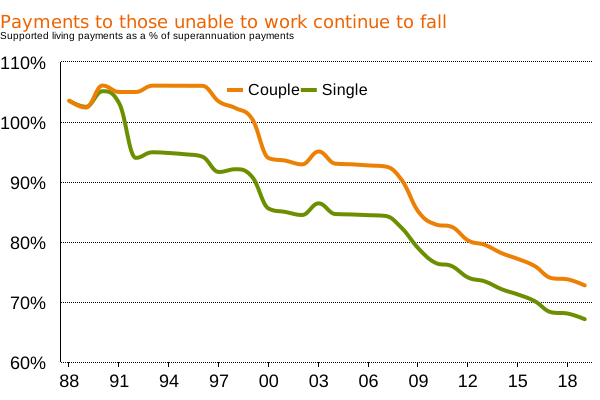
Ten years later in 1999, the single-person SLP was just below the single-person superannuation rate (at 94%). It has slipped even further since, to 83% of the single-person superannuation rate in 2010, and in 2019 is currently worth just 73% of the single-person superannuation rate.
Superannuation keeps pace with wages, but disability payments fall
Over time, supported living payments have also declined as a proportion of average weekly wages. This decline has occurred even as superannuation payments have remained a steady proportion of average weekly wages. Having SLPs decline relative to the average weekly wage indicates that although workers and superannuitants have maintained a similar trend of living quality, those physically unable to work have seen the funds they receive dwindle lower even as costs increase.
Over the past thirty years, SLPs have declined from 33% of the average weekly wage in 1989 to 26% in 2018 – a eight percentage point decrease (see Graph 2).
Graph 2
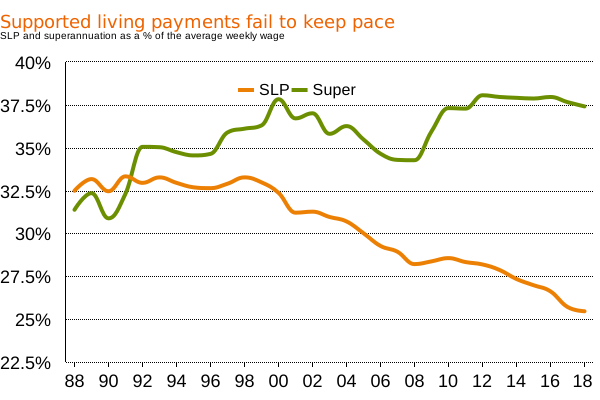
Over the same period, superannuation as a proportion of the average wage has actually increased, from 32% in 1989 to 37% in 2018 – a five percentage point increase.
It should be noted that there are added payments that someone can receive through the benefit system based on need, including the Accommodation Supplement, disability payments for regular health costs, special disability payments, and the community services card.
However, these additions can be accessed by someone on superannuation as well as the SLP – hence why the disparity in base payment rates is uniquely unfair. Furthermore, these additional payments don’t necessarily get provided to those in need .
Supported living payments must rise to protect those unable to work
This divergence in benefit payments to the old and the disabled implies that the support society should provide to the old is greater than the support for the disabled – a sad reflection when previously society valued both similarly in recognition that they could not work themselves.
That’s not to say that those receiving superannuation should receive less (that’s a totally separate aspect), but instead that those unable to work due to health conditions should be paid at a similar if not the same rate as superannuation.
It’s also important to point out that there are many different views about whether certain minimum incomes (like superannuation or supported living payments) are sufficient or not for individuals. But given we commonly discuss superannuation as a “top-up” to a retiree’s income, and that it would be difficult to get by on superannuation payments alone, it’s highly concerning that New Zealand provides a much lower payment to those unable to work due to health conditions.
Someone who has had an entire working life to save income for their retirement may have been unable to or may have faced difficult circumstances and hence deserve our support. That’s not at question. But someone suffering from a disability that keeps them permanently out of the labour market has, at most, a limited opportunity to access the labour market to try to gain income for their livelihood. This lack of opportunity justifies why someone receiving a supported living payment should be paid at least the same if not more than the superannuation rate – not less.
To be clear, receiving a supported living payment isn’t a case of someone avoiding work. Work testing for this benefit must occur every two years, even though they also need to show the condition is keeping them permanently out of work. For those who receive SLP, the lower payments are probably not the most important issue they struggle with –when many people receiving this payment want the opportunity to be involved in the labour market, want fair payment for those who support them (especially family members), and are concerned about negative social treatment due to their condition. But treating these people in the same way we treat others would be a start.
As a society, we value the idea that we give people the same opportunity to live a good life. When someone is dealt a rough hand, as a community we should do more to support them. Our willingness to let payments to those with disabilities decline relative to those on superannuation and relative to the average wage indicates either a lack of empathy, or an inadvertent hypocrisy in terms of the way we have established our support for those unable to work themselves.
It seems only right that we correct the unequal benefit payments, starting by increasing supported living payments to the same level as superannuation, and then keeping payments in line with superannuation and wage rises.
]]>
The term “secular stagnation” was introduced by Alvin Hansen in 1938 and revived by Larry Summers in his speech at IMF in 2013.
A lot of threads are tied together when discussing these ideas, but my understanding is as follows. An economy in a secular stagnation suffers from insufficient demand for goods and services at an interest rate of zero. Nominal interest rates below zero are necessary to ensure that factors of production are fully utilised, however it is not possible (or perhaps technically or politically feasible) to do this.
As a result, government policies that would normally be accused of driving up interest rates could be used to drive up demand.
Causes of secular stagnation
At face value this sounds a bit like a free lunch – there are resources that are unused, and the government can decide to spend and use them. So what are some of the reasons that have been posited that may allow for this?
- Ageing population,
- low productivity growth/expected future growth,
- technological advancement,
- income inequality
- and surge in the digital economy.
That is not to say that these are the causes – that deserves a post of its own. But if there are reasons, why do we care?
Why is it a concern?
When we are stuck in a situation like secular stagnation – where insufficient demand persists for a long time – it becomes a concern for a wider economy. Two ways I like to think about this are:
- Multiple equilibria concern – due to expectations the economy can be trapped in a low output equilibrium which is Pareto inferior.
- Hysteresis concern – when a negative demand shock happens in a short-term, it will have enduring effect in long-run. For instance, a negative labour demand shock can impact economy detrimentally in long-run due to the loss of the skills.
Larry Summers argues that conventional monetary policy is weak to cope with this situation, and proposes to use alternative unconventional monetary policy tools such as fiscal policy stimulus to raise demand. (https://www.brookings.edu/wp-content/uploads/2019/03/On-Falling-Neutral-Real-Rates-Fiscal-Policy-and-the-Risk-of-Secular-Stagnation.pdf)
“Policymakers going forward will need to engage in some combination of greater tolerance of budget deficits, unconventional monetary policies and structural measures to promote private investment and absorb private saving if full employment is to be maintained and inflation targets are to be hit”
We need to be careful with the hypothesis of secular stagnation
There are two completely different hypotheses standing behind the secular stagnation issue.
- The neutral rate has fallen. Here we are saying that the natural interest rate is lower and long-term growth is lower.
- An earlier large shock threw the economy out of whack. Here we are stuck in a “sunspot” where low growth expectations are self-reinforcing, keeping interest rates lower.
Before rushing into diagnosis, we need to carefully consider which hypothesis we strongly believe in causation of secular stagnation.
The first hypothesis is saying that we have reached our limits, and economy cannot do anything else, and we should just accept a new level of lower economic growth. This is what Hansen was talking about prior to the WWII, which proved that he was actually wrong. Post-war and post-great depression economy has shown tremendous booms and a different level of economic capacity.
The second hypothesis allows us to think of possible alternative solutions central banks could think of in order to pull economy out of the low rate trap.
One issue with secular stagnation as it is framed is that “persistent insufficient demand” is a poorly defined concept – and at some point the new normal of lower growth is accepted as truth. However, as the failure of this hypothesis in the 1940s and 1950s indicates large economic shocks can create sunspots – and if that is what has happened then more active government provides a solution.
Although I have huge respect for Summers, in this way it feels like Larry wants to have his cake and eat it too – simultaneously claiming that there are real reasons why growth is low, but then suggesting there could be a scope for activist fiscal policy. By saying both it is hard to ever be wrong, but it is also hard to develop appropriate policy.
]]>
Anyone who reads this who also read my writing pre-2014 will remember that I was a strong post-distributionalist when it comes to social insurance policy. To the point where the term pre-distribution (or predistribution) did not appear on TVHE when I did a search.
Since then the economic environment has changed and I have spent more time considering these issues. So have my views changed? Let’s consider the issue.
Tl;dr No, but I think the terminology can be used more clearly. With regards to redistribution – if our concern is the distribution of income alone pre-distributionalist policies are indirect and inefficient. But pre-distribution policy prescriptions have relevance when discussing issues of transition – which is essentially insurance from shocks, and the provision of job/income security (as apart from a security net). Such insurance can be costly, but is still worth discussing in this frame. Furthermore, if we stretch the term pre-distribution far enough it becomes ridiculous – sure the whole study of economics concerns the distribution of income, but the name is used for a subfield for a reason.
Definitions
Contrary to Wikipedia pre-distributionalist policies are not new. Until the reforms of the Fourth Labour government in New Zealand, New Zealand social policy was heavily pre-distributionalist. Now this, from the bat, suggests to me that my definition of pre-distributionalism (which is based on reading of welfare and tax policy history in Australiasia and Scandanavia where this term can be used to differentiate from tax-transfer policies) may differ from modern discussions (which I have not read). That is fine by me but I will try to be clear on issues below so it is obvious what I am talking about.
So what is pre-distributionalism as I discuss it here? I have always interpreted it as stating that a pre-distributionist redistributes the means and structures for generating income prior to trade occurring, rather than redistributing the income generated from trade (post-distribution). In both cases the purpose of this policy is then to redistribute income to deal with some perceived inequity in society.
A post-distributionalist policy would be something like an unemployment benefit, while a pre-distributionalist policy would refer to a government guaranteed job at a given wage rate for a worker in an industry that is fading away. A post-distributionalist policy would be to provide a family benefit for those with children, while a pre-distributionalist policy would be to influence wage rates in industries where parents tend to work to increase their market incomes. Both are redistributing income and providing a form of income security – but the incentives, costs, and benefits differ.
Now I’ve heard that pre-distributionalism can be steered away from the line that it is redistributional – instead stating that they are preventing inequalities from occurring at the source. I dislike this, as it makes the success of pre-distributionalist policies untestable – if income inequality was to fall they would claim success (through redistribution) and if it didn’t they would claim that the underlying inequality they were dealing with was dealt with by definition. If there is a “non-income” type of inequality we are targeting, then any dichotomy between pre and post-distributionalist policies is false, as the only real point of post-distributionalist policies is to change the distribution of income. Note: Many “inequalities” are in fact unobservable or are justifiable.
But this cuts to the heart of the issue – if we are going to evaluate policies we actually need to define what the aim of the policy is. In this way I would argue that we can split policy targets into three when it comes to setting these policy schemes: The first two are static – the level and dispersion of income/final goods and services. The third is dynamic, in the face of shocks who bears the risk.
You may argue there is a fourth string – that the structure of returns are efficient and equitable! If that is where pre-distributionalists are referring to then all they are saying then the entire term is pointless for two reasons – as it refers to all policies that are not tax and benefit policies, and refers to their final evaluation rather than a description of their distributional properties! Note: Post-distributionalists don’t get off scott-free here for jumping too quickly to welfare evaluation – this is a whole other kettle of fish though.
So yes these policies influence the distribution of income, but the distribution is not the “purpose” of them – instead they are targeting some other equity or efficiency principle. This is the same category error people make with monetary policy and financial stability.
What do I mean – yes we should talk about the distributional impact of all policies, but the “target” of all policies shouldn’t be focused on its impact on the distribution of income … or even worse some undefined inequality that we will just say is solved as a result of our pet policy .
Note: If someone was to say “I think competition policy is more relevant to welfare than something that merely targets reducing the observed inequality in incomes” I would say “yup”. But by saying you are a type of “distributionalist” you are stating that the primary concern of your discipline is the distribution of income. Also remember that someone who focuses on post-distributionalist policies doesn’t disavow other policies – they just aren’t trying to move every potential policy recommendation into their field of research …
The distribution of income
What is the distribution of income? We can think about it in the following way – we have some characteristics (I’m male, 32, eat poorly, have experience working as an economist, and like to argue far too much) and the market offers us a set of potential jobs given these characteristics. They offer different combinations of income, work satisfaction, and leisure – we then fall into one in some way. On top of that if we are endowed with resources we can save them in some way where there is a set of risk-reward opportunities for our saving – these generate income.
Nice.
So the distribution of income depends on endowments (savings, characteristics) and the return on offer for these.
Nothing in this about the fairness generating the process – and the process itself is very much a function of policy. However, after we have introduced a series of policies that give a “structure of returns that are efficient and equitable” is the outcome just? Maybe, but maybe not – due to insufficient information about the income generating process or due to luck.
As a result, we in turn justify redistribution.
Redistribution of income
If all we care about is income alone, then post-distributionalist policies get us where we want to go with certainty – in that way, they give us greater income security and horizontal equity over the population as a whole.
For example a job guarantee may offer an individual greater income security than the existence of a safety net – but if those guarantees are in areas that are unprofitable this is really a benefit payment from society. By making broader society bear the risk that the job has value you creating uncertainty about the required tax. Furthermore as this person has a higher guaranteed income than people with otherwise identical characteristics by virtue of having this job, there is horizontal inequity.
Furthermore, we can do a better job of targeting with post-distribution – as at this point we have “observed” things such as luck, or the product of unobserved characteristics (observed income). As a result, redistribution that will have been missed by pre-distribution gets picked up by post-distribution – but this does not happen the other way.
In terms of efficiency it is often assumed that post-distributional policies are superior to pre-distributional policies. After all, job guarantees keep people working in roles where they are producing little, while a social safety net clearly demarcates the difference between work and benefit income – incentivising people to look for roles where their work is valued.
Job schemes in New Zealand helped to hold down the reported unemployment rate in New Zealand through the 1970s and early 1980s, but they were incredibly wasteful – in most cases providing people differential benefit levels for not doing much.
But this does ignore something – people were still going to a job, a job they did not believe would disappear. And that leads us into another separate issue.
Economic security
Now, post-distributional policies are sufficient for economic security when shocks are only very small – they provide a safety net, and people are relatively fluidly able to move being job types. Such policies are set given considerations of relative status and equity already and so there is no need to consider more active intervention.
But technological change, globalisation, and the GFC (which arguably helped to speed up some of these changes) imply a situation where the return to the skills people have has changed significantly – with some people rewarded for training in areas that are complementary to technological change while others have seen their income and job prospects disappear.
We should not want to make the past reappear. Technological change and globalisation generate wealth. But, arguably, we may believe that such a change is only fair if the losers are compensated by the winners – if the compensation we discuss for Kaldor-Hicks efficiency actually takes place.
Now this is an issue I find incredibly difficult. This is an area I do not envy policy makers. We cannot just tax the winners from globalisation and give income to those who, in the absense of change, would have been better off as:
- We don’t have sufficient information
- If we view it in too static a sense, it may excessive mute incentives for people to develop skills that suit the new reality
- Income isn’t the only issue that matters – pride in having a task you perform well and the status that gives you in your community are also important, and are lost.
As a result, arguably a potential pareto improvement from a policy involves both pre and post-distributionalist policies. Furthermore, the cost-benefit analysis of such policy changes needs to count such transitional shocks.
Now, this is already how economists generally consider such issues. Look at this article by Benje Patterson from 2013.
A generation of workers in Southland’s labour market have become institutionalised in the Tiwai environment. Subsidised power led to the creation of well-paid positions and accrual of skills that would not have otherwise been demanded by the wider labour market. This artificial disjoint would leave some former Tiwai employees with a tricky transition into comparably paying employment should the smelter close.
Parallels can be drawn between the current situation for Tiwai’s employees and car assembly workers left jobless in the late 1990s. Both industries flourished because of some form of government intervention. Tiwai survives because of preferential power pricing, while New Zealand’s car assembly industry only ever existed due to sizeable import tariffs on cars.
Not surprisingly, when the government decided to withdraw these protective motor vehicle tariffs in 1998, domestic assembly plants could not compete with the price of imported vehicles and were forced to shut down. These closures left thousands of car assembly workers jobless. As with Tiwai, many of these assembly workers had dedicated a large proportion of their working life to an industry whose labour demands were quite different to those of New Zealand’s broader labour market. However, despite this disjoint, additional support from the government to help with their transition into other employment was not forthcoming. The government gave a mere $400,000 of funding for communities affected by car assembly job losses on top of normal social support and employment assistance.
I find this lack of additional support somewhat callous. Car assembly workers had acquired a specific skillset on the understanding that society wanted to support the industry, as a result, the government’s decision to remove car industry tariffs essentially boiled down to changing an implicit social contract. The government should have recognised its role in the problem and gone out of its way to assist these workers’ reintegration into the labour market. It was a change in government policies that undermined the value of the human capital these workers had developed – which suggests that as a matter of fairness, these workers should be compensated for that loss.
Pre-distributionalist policies (at least the ones that make sense) occur within the scope of compensation for an economic shock. These are positive sum games where some of the people involved have lost out – if we want to make sure people in society are still willing to play these games, we have to ensure that they aren’t (and don’t feel) taken advantage of.
If this is the crux of the discussion around pre-distributionalism then it is worth talking about.
If pre-distributionalism is really about power structures and competition policies using different terminology then that is nice and all, but I don’t see the need when a clearly communicated prior literature on these issues already exists – and requires absolutely no conflict with post-distributionalist policy.
]]>Why austerity?
Osborne claimed that his rapid deficit reduction improved confidence across the economy, which caused demand to recover and growth to return.
Why a fiscal rule requiring an overall surplus in every year?
- Paying down debt in time of growth makes sense, so a surplus is required.
- Rules based on cyclically-adjusted measures and forecast targets—such as the present, five-year rolling structural current balance requirement—have huge measurement problems, which makes them a less effective constraint on Government policy.
- He felt that the debt targets, which were anchored to a particular year, were the harder constraint on his actions in the past Parliament. The new requirement for a surplus each year is a similarly hard constraint and is intended to be so to effectively constrain future Chancellors.
- The overall surplus is used instead of the current balance for two reasons: splitting current from capital expenditure allows gaming of the rules, and also leads to an undesirably negative framing of current expenditure.
Ring fences
Osborne was unapologetic about using ring-fences to protect particular areas of Government spending. He characterised them as simple heuristics that clearly set out the spending priorities of the Government.

This leads the SMF to express concern that school choice may not lift educational achievement because some parents do not consider it important. They then recommend Government intervention to promote the primacy of academic success. The line they’re treading between free choice and paternalism is a fine one. One the one hand, they want free school choice to improve the quality of schooling. On the other hand, they have a prescriptive view of what school quality means.
It is a difficult area because the parents cannot be assumed to be acting perfectly in the interests of their child. But, if we really think that the Government knows a child’s interests better than the parents then should we be promoting school choice as a mechanism for improvement? And if we want variation in schools to reflect the local community’s values then is it right to intervene when parents’ values are not the same as policy-makers’?
]]>Discussions of behavioural work among economists usually revolve around whether the discovered heuristic or deviation from ‘perfect rationality’ is policy relevant. They argue over whether it requires a policy intervention and whether an intervention would increase welfare from the individual’s perspective. Chetty bypasses that discussion to demonstrate how understanding of people’s biases can help the Government to control their actions.
For example, when he talks about changing defaults to encourage saving he takes it as given that it is a worthwhile objective of policy. He’d have no argument from me that improving outcomes for the least cost is worthwhile, but assuming that saving rates are too low begs the question. Why is it that people are saving too little? Are their behavioural biases truly a policy-relevant problem?
By decoupling the normative questions from the positive interventions, Chetty makes economics a tool for effective intervention rather than a tool for improving outcomes and individual welfare. I’m sure that’s very helpful for government analysts who know what they want but it is not the road to better policy. We’ve often talked on this blog about recognising normative assumptions implicit in policy decisions. But we say that to encourage debate about the right framework for considering them, not to sidestep them altogether. Chetty’s approach is undoubtedly useful and may be pragmatic but I can’t help feeling very uncomfortable about its amoral view of the world.
]]>