
Small town dynamics

By international standards, New Zealand is a small town economy. True, Auckland now has more than 1.5 million people, but by global metrics this is not very large. In 2010 there were 449 cities with more than 1 million residents, and Auckland was ranked 307 in terms of population. Small beans indeed – even if Auckland is four times as large as the next two biggest cities in New Zealand.

So how does this small size influence outcomes for New Zealanders?

Read more
How does nominal income targeting work?

Thanks to Dr. Kirdan Lees for prompting me to write today’s post. Today’s topic of discussion is nominal income targeting.

What is nominal income targeting? 

Nominal income targeting is usually viewed as an alternative monetary strategy to inflation targeting, and has never explicitly been applied in practice by any central bank. However, there is an overwhelming amount of literature discussing this monetary policy tool and how it compares to the flexible (inflation) targeting.

Read more

Land taxes and the Zero-Carbon Act

The Zero-Carbon Act means New Zealand is to accelerate the transition to an economy that uses fewer carbon-fossil based energy sources. Given what we know about the problems of global warming, a future in which most energy is renewable is to be welcomed. (As a life-long bicycle commuter, I also hope this future involves fewer cars, to raise the probability I shall live long enough to see it.) 

However, such a transition may require public investment and redistribution to help certain groups who suffer disproportionately from the changes – implying that feasible externality taxes may not be enough. If so there may be a case for land taxes to help fill this gap.

Read more

Randomized control trials and economic models: friends or foes?

Randomized control trial (RTC) studies are getting more and more attention among policymakers in the last few decades. In addition, the RCT is one of the core experimental methodologies used by the recent nobel prize laureates in economics Duflo, Kremer and Banerjee

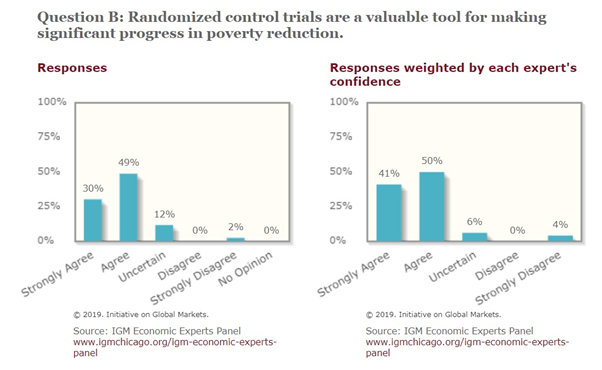
Given the excitement around these methods, Chicago University has recently run the IGM Economic Experts Panel asking economic experts on whether the “ Randomized control trials are a valuable tool for making significant progress in poverty reduction”. The results of the poll are summarized in the graph below. 

The chart above highlights respondents’ agreement distribution. What struck me most from the results was Angus Deaton’s strong disagreement with the statement – especially given that he is an expert in the field.

Read more

Measuring “OK Boomer”

In a sense OK Boomer has a history as long as the lives of Baby Boomers themselves – at least if we relate such things to the overlapping generations models in economics.

Read more

Should a central bank target wage inflation instead of price stability?

Olivier Blanchard’s recent speech at the Brookings Institution event “What’s (not) up with inflation?” encouraged me to write this post.

Blanchard is still my second favourite economist (after Matt Nolan of course 🙂 ). But despite that I felt that some of the important elements of the discussion was missing, and I didn’t fully agree with some of Blanchard’s arguments on GDP inflation being used in the same way as the CPI inflation, which needs a separate post perhaps.

Today I want to discuss wage inflation, price inflation, and central bank targets.

Read more