Flexible working hours – Genius or madness

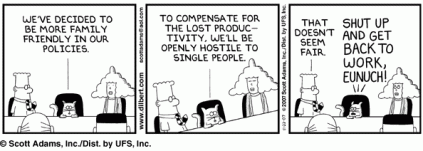
flexible-family.gif

The flexible working hours bill aims to increase the degree of ‘flexibility‘ in the labour market for households with a child under the age of 5 or a disabled child under the age of 18. Now I’ve heard all sorts of complaints and complements about this bill, so I’ll try to talk about the way I see it.

Read more

Higher interest rates – stronger currency?

In the comments Kimble had a great point “long term estimates of the level of the dollar can be heavily influenced by the current level”. Although this may seem like economists being myopic, it has more to do with our extremely limited understanding of how the exchange rate works.

Read more

Do US rates need to fall again?

What do we have here, the Fed has lowered growth and inflation forecasts, Freddie Mac (a US based mortgage finance company – think subprime mortgages) suffered record losses, Citibank and Bank of America struggle with credit concerns, and the MIT real estate center recorded a fall in commercial property prices (and the first fall in commercial property values since 2003). On the back of this, the Fed feels the decision to cut rates again is on a knife-edge, with market sentiment pointing to a fall.

Read more

The Halo Effect: Round Two

In a previous post we discussed the Halo effect, and how the Warehouse was trying to claim it was their own idea. Since then, the Halo effect has taken on special importance as Woolworths Ltd (Aus) and Foodstuffs decided to appeal the Commerce Commission’s decision to refuse to let one of these firms buy the Warehouse.

Read more

Corporations and welfare

bizarro.gif

This cartoon tells us a number of things about the situation. Firstly, for Walmart to put this mans firm out of business, Walmart must have been relatively more efficient (ie, its costs were either lower or the value they added to the product was greater). Secondly, it tells us that the person that used to have a firm is worse off than he was when he did have his firm (as he now only makes enough to shop at Walmart, when before he could afford to go to boutique stores).

Read more

Patents not so evil after all…

We’ve previously blogged about the potential for patent protections to restrict innovation when inventions are sequential. However, Sudipto Bhattacharya and Sergei Guriev suggest on VoxEU that the research we cited by Bessen and Maskin might be misleading. In particular they point out that there is a ‘third way’ that knowledge can be treated.

Rather than patent it or make it public, a firm may choose to simply keep the information private as a trade secret. It can then be licenced to a vendor in return for royalties. Unfortunately, this is less efficient than patents because the vendor will under-invest in development of the technology. Essentially this is because the vendor bears the whole cost of further development but is forced to pay a portion of the revenue generated from that investment to the original inventor in the form of royalties. The authors claim that decreasing patent protections could thus cause more inventions to be kept secret and inefficiently licenced, which reduces total welfare.

As a consequence is that the number of ideas available to firms to develop is probably a concave function of the level of patent protection, with an interior maximum! With no patent protections ideas are kept as trade secrets and handed out under exclusive licences. With full patent protection it is too costly to licence the patent and develop the idea. In both cases the level of innovation will be low. Somewhere in between is the ideal level of intellectual property rights enforcement. So even if innovation is sequential, reducing patent protections has the potential to stifle further invention, although not for the reasons usually cited.

NB. Besson and Maskin’s paper isn’t directly comparable with the Vox paper: the former use complementarities to drive their result while the latter exclude such complementarities and allow for private information. Bhattacharya and Guriev are therefore considering a more general problem than B & M, which is why I describe reliance on the B & M result as misleading: it doesn’t represent the vast majority of industries in which patents are used.