Film incentives are trade protectionism

If we follow Australia down the road of trade protectionism for movies, then we all lose out.  What do I mean?

Well the incentives for trade protectionism is a prisoner’s dilemma.

As Peter Jackson says, if Australia starts subsidising movies we need to do the same or we will miss out on productions – as a result our best response to their protectionism is more protectionism.  Furthermore, if we start subsidising and Australia doesn’t then we get a relatively larger share of the movie industry – assume that this occurs to the point where the tax revenue from the movies exceeds the cost of the subsidies.  In this case our best response is to ALWAYS subsidise.

However, there are two issues.  Firstly it is in Australia’s interest to subsidise (it is also their “dominant strategy”).  And secondly, the decision to subsidise pays off because it hurts Australia.  In the end both countries end up subsidising movies, and both sets of taxpayers end up worse off than in the case when neither country subsidises.

This is the issue, not only with the subsidies on movies, but on all trade protectionism.  That is why we need international co-operation to avoid this type of beggar thy neighbour behaviour.

On football player agents’ fee structures and incentives

Recently Premier League clubs in the UK have disclosed the amount of money they are spending on football player agents’ fees. These agents act as middle men between players and clubs, facilitating the transfer of players. Some of the more interesting information revealed in the disclosure includes:

  • Premier League clubs are paying almost £2 million a week to agents in commission;
  • The 20 English top flight clubs disclosed they spent £70.7 million on agents’ fees last season alone;
  • Manchester City were by far the biggest spenders, splashing out almost £13 million during dates covering last winter and the recently closed summer transfer window;
  • Chelsea paid out about £9.5 million – the second highest – with Liverpool third on £6.7m; and
  • Burnley parted with the least amount – less than £500,000.

Agents are typically paid a percentage of a player’s transfer fee. The nature of this payment structure means that agents have an incentive to encourage players to transfer regularly, as they are able to ‘clip the ticket’ each time.

Furthermore, agents have an incentive to encourage ‘high’ transfer fees, as they profit more from such moves. One common tactic from agents to try and push up the price of their players is to link them with big clubs (links which media appear all too happy to report on). Just recently, Spurs’ Russian striker Pavlyuchenko was linked with a move to North London rivals Arsenal, for example. Such ludicrous rumours are designed to wrangle more money off clubs genuinely interested in such a player, such as Zenit St Petersburg and Spartak Moscow.

Sounds like a good line of work if you can get it.

Land tax and benefits, a point to think on

Land tax.  It is a popular idea among economists.

However, I have heard some people pushing it based on getting land “in use” (this was mentioned at Kiwiblog for example).  I am not sure if I agree on this point.

Saying that we should tax land so people use it is similar to saying we should cut benefits to get labour “in use”.  Both these arguments involve increasing individual costs to get “activity” going.  This isn’t necessarily welfare optimal.  Remember the goal of policy is not to increase productivity or to get our GDP number as big as possible, it is to ensure that we have a society where net happiness is as high as possible.

Focusing on getting things “in use” by pushing a cost on private individuals does not ensure that net happiness will be higher, and is definitely a violation of the principal for policy we suggested here that:

Any regulation should be based on the idea of avoiding coercion either from the private or the public sector

Arbitrarily adding costs to get people to arbitrarily do other things is coercion, and I don’t know if I can support the actions of any private or public agents that are based solely on coercion.

I like a land tax as a replacement for other taxes given that the elasticities of supply and demand are low – implying that the “deadweight loss” from taxation will be relatively low.  Furthermore, the tax on land is a “fixed cost” of production, implying that the impact on downstream costs should be minimal (depending on how this changes relative land use in the long-run of course).

These reasons are not related to some arbitrary goal of maximising statistics, but instead on the idea that we should be trying to raise any target level of revenue at the lowest possible social cost.

Cubicle cows

I am torn.

I the one hand I immediately feel uncomfortable with the idea, as I don’t naturally feel that being constrained will maximise animal welfare (which is the reason why you would want to constrain the actions of the farmer).  This comes from the “factory farm” argument.

On the other hand, I don’t know how these “cubicles” make the animal feel – could it be that they are happier in them?  I don’t know exactly what these cubicles are like, and whether an “investment” in them would actually be beneficial for cow welfare.

This way of framing the argument says “it is costly for farmers to invest these in facilities that will improve animal welfare, so they are doing too little” – actually implying the opposite result to the factory farming argument.

A few weeks ago I was at a presentation on dairy cow welfare.  In it the presenter was complaining that farmers had invested too little in these sorts of facilities, as in many ways (the animals health, ease of getting to feed, stress levels) these facilities would improve animal welfare.  If this is true I would have to say I am pro.

However, I do not know enough about the current scheme, or the preferences of cows, to decide whether I think it is a good idea.  Hopefully, any policy will explore the impact on animal welfare before we policy is made.

I do have one strong view though.  Stop sending me facebook group invites suggesting that I should sign a petition.

F**k being a banker …

Seriously, so the UK is going to arbitrarily tax bonuses at 50% because they are not “generating real wealth” they are just “rent seeking” (Will Hutton and Paul Krugman feel this way).  Wow.

The decision to pay a wage, or a bonus, is voluntary.  Given that these bankers are creating sufficient value through their work to extract these wages/bonuses why shouldn’t they get their wage/bonus.  They are generating sufficient “wealth” through their activities – or else they would i) get undercut by other labour, ii) not get paid by clients.

Yes the organisations that got bailed out should have to pay back their bailouts.  Yes, we should try to avoid the current moral hazard problem that could exist in the industry (on the basis of the bailouts mind you – which is government intervention). However, shouldn’t the solutions to these issues be focused on the actual issues – rather than arbitrarily attacking bonuses (which will simply be delayed to avoid the tax for those that can afford it).

If we think that the price paid for the financial labour service is out of whack because of some sort of direct market failure then tax it.  If we are trying to work out optimal tax and we find that the supply and demand for these services is perfectly inelastic, potentially shift the tax burden.  But that isn’t what the authors are doing.  They are accusing bankers of being the equivalent of organised crime and then stating that we should punitively attack.  I’m sorry but I find this attitude simply abhorrent.

Seriously, if you have something specifically against bankers, lets apply the logic somewhere else:

UK is going to arbitrarily tax teachers at 50% because they are not “generating real wealth” they are just “rent seeking”

After all, teachers don’t build physical things they just provide a service like the bankers.  If we are going to attack bankers for there being a credit crisis, why don’t we just start taxing teachers more because we “feel like educational standards are too low”.

Update:  Stumbling and mumbling also believes bank bonuses should be hammered.  However, he at least paints his argument out in full and so deserves to be heard.  I don’t agree, but that isn’t really the point 😉

Who’s the real villain?

Keith Ng writes today that the real villain in climate change is not businesses, it’s households! He claims that most growth in emissions and energy consumption is due to household consumption, not businesses. Which is the biggest red herring I’ve seen around climate change in a while.

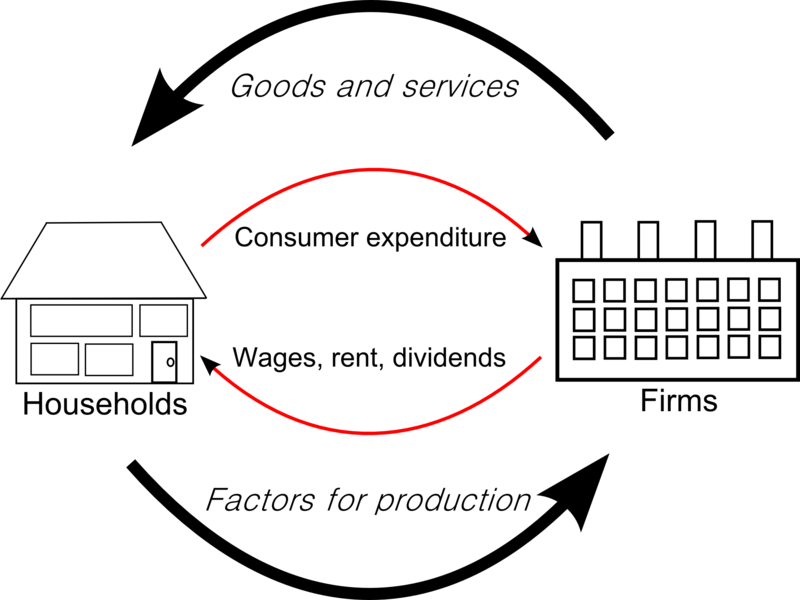
Here’s a picture that will help: it shows how everything in the economy is actually linked together so considering household and business emissions separately makes no sense.
Circular flow of income

Now that may be a little simplistic but it’s good enough for our purposes here. Household emissions are measured by looking at the emissions generated in the production of goods that the household consumes. So the emissions come from producers, but the final product is consumed by households. Households provide the demand that causes the creation of goods that generate emissions in their production. So households are really responsible for ALL emissions. All emissions??? Yes, ALL of them.

What about businesses emissions? Well, businesses use goods to enable the production of other goods that households end up consuming. If there were no households buying things then there’d be no businesses making things. So this whole distinction between households’ and businesses’ emissions is really rather confusing, and more of a statistical device than a real division: one would not exist without the other.
Read more