The UK: agglomerating since forever

Agglomeration externalities are the hot thing in policy these days. For believers they’re one of the things that economists have missed by excluding geography in the past. To sceptics they’re just another excuse for the Government to justify picking winners and organising the country. I recently came across a couple of VoxEU articles that might point the way to a reasonably middle ground. Read more

Economics sucks, it is just the study of ‘common sense’

This is a view I hear all the time, a view that (in my view and given how it is often framed) completely misses the point of economics, social science, and even common sense!

Common sense is an important thing to keep in mind, and the concept undeniably has a place when thinking about the application of economic ideas, or the reference point from where the social sciences should put effort into building understanding.

Common sense refers to judgements, knowledge, and beliefs that are shared between people. The context I’m using here is a touch weaker – but similar to the more common definition:

Common sense is a basic ability to perceiveunderstand, and judge things which is shared by (“common to”) nearly all people, and can be reasonably expected of nearly all people without any need for debate

The main difference is that this is descriptive of the way common sense is treated, not an indication of the way we should treat it 😉

Read more

School zoning perpetuates inequalities in society

So says David Grimmond in his discussion of school zoning! (Infometrics link here)

I am not a fan of school zoning.  Its main outcome is to reduce school choices for poorer families.  Although the intentions underpinning the policy are probably noble, it has unintended consequences which on the whole harm the prospects of children from poorer households.

Zoning adds another incentive to move into a community filled with people that are “like” you.  As we know from Schelling, a small incentive for such things can quickly lead to complete segregation.  Rather than enforcing greater equality in the school system, zoning is a feel good policy that ends up reinforcing broader inequalities!

If we honesty want to ensure education provides for everyone in society, David suggests:

It is too simplistic to presume that alternatives to the public system will be sufficient to generate education improvements.  Indeed, the US experience demonstrates that there is a mix of outcomes from charter schools.  But what the US experience with charter schools has provided is the opportunity to learn from their experimentation.  My reading of this evidence is that there are at least three areas that schools can focus on to improve education outcomes:

  • Ensuring that the school maintains standards about expected student behaviour
  • Openly assessing, reviewing, and improving teaching methods
  • Directing better teachers towards students who have the greatest need for improved education outcomes.

Our competitive nature is not natural

The heart of economics is an understanding of human choice. Our theories are almost all constructed on a utilitarian model of preferences and choice so understanding how we can improve that model is crucial to progress. Plenty of work has been done by behavioural empiricists on the heuristics that guide our behaviour and the anomalies in our choices. Now a paper by Leibbrandt, Gneezy, and List demonstrates that preferences also change over time in a predictable way. Read more

When forward guidance doesn’t guide

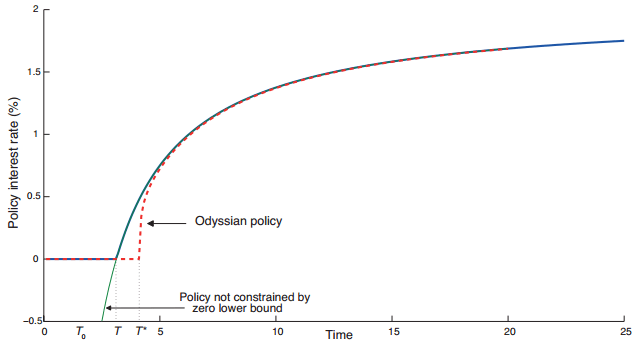
VoxEU have recently launched a book on forward guidance and it has demonstrated wonderfully my ignorance of central banking. I thought that when bankers issued ‘forward guidance’ they were doing it to escape the zero lower bound by promising to keep rates lower for longer than they normally would. Something like this:

Source: VoxEU eBook

Source: VoxEU eBook


The ‘Odyssian’ guidance seeks to lift nominal expectations by promising not to tighten policy in future. For a while, the bank’s policy rate will dip below the level you’d expect if they were never at the ZLB. That is the sort of guidance that the Bank of England has explicitly disavowed. Read more

Quote of the day: Lambert and value judgments

I was excited to see James post about value judgments this morning – as that is exactly what I was about to throw a brief post on!  Partially motivated by this:

But also motivated by the fact I’ve been reading a bunch of ‘normative economics’ recently.  Here in the book “The Distribution and Redistribution of Income” by Peter Lambert is a quote about value judgments (with reference to, in this case, income inequality measures)”

It is hard to avoid making (often well-concealed) value judgments when assessing inequality

The points he goes on to make regarding valuing income distributions given certain measures are relatively well known, but worth repeating: Read more