Scarcity easing in manufacturing?

For all the talk both within New Zealand and abroad not enough time is given to the hypothesis that it is in fact improvements in technology that are “hollowing out” the manufacturing sector … and that what we really need to help the unemployed is availability to skills training, rather than trying to prop up inefficient domestic jobs in current manufacturing industries.

And yet, there is an increasing amount of evidence that this is the case (via Matt Yglesias).

Increasing output with fewer inputs is a good thing – but when labour is one of the inputs involved we know there may be losers.  If this is really what is happening, then as a nation I would suggest that we try to integrate education and benefit policy more fully, stop demonising those who are out of work arbitrarily, and also stop talking about intervening to “create jobs” in industries that are likely to be long term losers … give people opportunities in this ever changing, and technologically improving, world.

This is, after all, the same sort of thing that happened with the primary industries – with less and less labour needed to dig up coal and produce food.  Work is a cost, it is the income people get from working with a capital owner that is missed when something like this happens.  And it is this fact that we need to keep in mind.

And yet in New Zealand we have one political party talking about subsidising manufacturing and the other political party talking about how lazy the unemployed are.   It makes me a sad panda.

Cliff notes on the financial crisis

At work we are writing occasional articles for the fine people over at Rates Blog at the moment.  I’ve decided to focus on an issue that will get people irritated – an explanation of the GFC where I largely defend economists (although admiting that the mainstream missed the development of the shadow banking sector).

I’ve stuck with the view I’ve articulated in the past (as can be seen here with and with the links), but I’ve attempted to articulate it in a clearer fashion.  I’m aiming to have a related article out at some point trying to discuss why the crisis has persisted – after all in the article I’ve linked to above, if my explanation was true, the actions of the Fed and US Treasury should have led to the crisis being over by now.   My view is that policy failure in Europe put us on this darker and more persistent path.  The three other primary views are:

  1. Fed and US Treasury policies did nothing, and this is still in essence the same crisis.
  2. Financial crises, but default, are long and ardueous.
  3. This is irrelevant and monetary policy has just been too tight due to central bankers being more conservative.

I would note here that these views (including the one I posited) are not mutually exclusive, and each has a significant grain of truth to it.

Our explanation for the crisis matters right now because it determines what sort of policy response we think is right – which is the main reason why many analysts out there are purposefully “over-arguing” how confident they are about their explanation.  In truth, things are never as simple as they seem.

Note:  And before anyone starts saying that by defending economists on some level (even though I do appropriate blame on them as well) and therefore I’m being purely self serving regarding my own failure to publically warn about the crisis, I’d also note that I only started my job in 2007 – I was just starting to get used to data sources and writing about economics on a regular basis (including starting the blog) once the crisis had begun.

It would be in my interest to attack the establishment that was already in place and pretend to be a “fresh voice” – but unlike some economists around the world who seem quick to attack the rest of the discipine, and misrepresent the views of other economists to sell their own image, I’d prefer to take a bit more of a balanced view 😉 [this comment isn’t aimed at New Zealander commentators, just to make that clear].

Is advertising evil?

Vox says the data supports Matt’s priors:

There is an old debate in economic theory… about whether advertising increases or decreases the prices of consumer goods. Some have argued that advertising provides information to consumers, such as information on prices or the existence of products. This information increases the degree of competition in a market, and thereby lowers consumer prices. On the other hand, there is the view that advertising changes the preferences of consumers, for example by shifting demand curves outwards, increasing the monopoly power of brands or decreasing elasticities of substitution. All these effects should lead to an increase of market prices.

…advertising increased consumer prices in some industries such as alcohol, tobacco and transportation, in which the persuasive effect dominates. But it also decreased consumer prices in other industries such as food. …those industries which exhibit the informative price include more information in their advertisements, consistent with the interpretation of informational and persuasive forces of advertising.

The aggregate effect is informative, which means that, on average, advertising decreases consumer prices.

Also, a perspective from inside advertising.

Devious pricing?

Apparently UK supermarkets sometimes advertise deals that charge prices higher than the usual, listed price:

In the worst cases, Which? found that supermarkets doubled the shelf price of an item when they began promoting it as a money-saving multibuy. It found that Asda was selling a Goodfella’s Deep Pan Pepperoni pizza at a standard price of about £1, but when it went on to a multibuy deal, the price jumped to £2.50 for one or £4.50 for two.

What is conspicuously lacking from the report is the percentage of advertised deals that do not involve a saving. Mistakes happen, and there are plenty of ways in which a listed price could dip below the deal’s price if supermarkets regularly adjust prices. If only a few dozen examples of this could be found across the tens of thousands of deals that supermarkets advertise every year then I’d be tempted to chalk it up to errors, rather than devious pricing strategies.

Of course, it could be that supermarkets are systematically taking advantage of our decision heuristics, which would be far more exciting 🙂

Annals of improbable statistics: public choice edition

A bit late, but this case study is too good to pass up! The local Wellington newspaper reported that:

Wellington City Council’s strategy and policy committee this morning agreed to a joint plan by Positively Wellington Tourism, Grow Wellington and the council to implement the council’s new ”Destination Wellington” programme. … The proposal agreed to today will see the city’s tourism agency work to tell the ”Wellington story” [which] should return $50 for each $1 of council investment

If someone called you up offering a 5000% return on investment you might be a bit suspicious. Indeed, some councillors were:

Helene Ritchie arguing that… ”This is a significant amount of ratepayers’ money … We don’t know what we are going to achieve and how we are going to measure it, and we need to do that first.”

Unfortunately, she didn’t prevail:

…other councillors argued that… would just be putting up more red tape when they should be getting on with it.

Now, I don’t know the details of Grow Wellington’s plans, and they may well be excellent. For all I know, their only fault may be incredibly poor economic impact analysis. However, the council’s rationale for approving funding appears to be summed up by the final quote in the article:

You have to have a plan and that’s what people want to see – they want to see that we’re doing something.

This is why public choice theory exists!

Have election turnouts been falling?

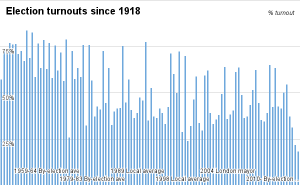
After appallingly poor turnouts in recent local elections in the UK The Guardian has a post implying that election turnouts have been falling over time. The key figure is this:

They also have a chart showing that smaller, less nationally important elections get a far lower turnout. Given that their time series data combines all election types, I was curious about how the time series broke down by category.

The first thing to note is that local elections (with lower average turnout) are far more prevalent in recent years, at least in The Guardian’s data. That immediately means that the overall trend will show a decline in turnout, even if turnout within categories hasn’t declined. Read more